
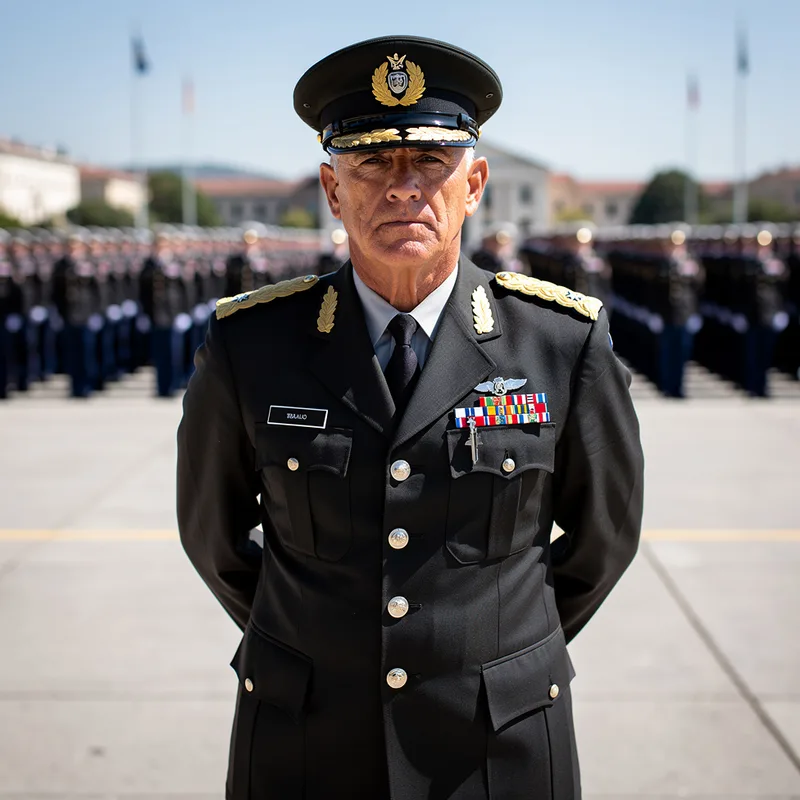
commandant
 34
8.2
34
8.2

- noun
- /ˌkɒmənˈdænt/
- Specialized
- Our commandant inspected the troops before their deployment.
- commandant of cadets
- camp commandant
- former commandant
Loading YouTube…
Watch on YouTubeFell to the Grand Commandant, who took care of broader scale administration and empire wide appointments.
- Fell to the Grand Commandant, who took care of broader scale administration and empire wide appointments.
- That is not the case here, or at least it was not the case in the former commandments commandant's time, right?
Examples
-
And then we got one from our commandant thanking us.
-
Brigadier General John A. Weida arrived at the Academy in April of 2003 as the new commandant of cadets.
Academic text (2007) -
This is your commandant speaking.
-
Take my offer to your commandant.
-
"The commandant was carrying out his promise."
-
Budzyn, under my command, was the envy of every other commandant in the labour camp system.
-
Allen completed his distinguished Coast Guard career as its 23rd commandant, retiring from that position in June 2010.
Academic text (2011) -
Prior to his assignment as commandant, Adm. Allen served as Coast Guard chief of staff.
Academic text (2011) -
Stangl had been commandant of the Sobibor and Treblinka death camps.
Academic text (2011) -
General Weida earned a second star and has since been replaced by a new commandant of cadets, Brigadier General Susan Desjardins.
Academic text (2007)
Synonyms
 ∞
3.6
∞
3.6
A person in charge of a group who gives orders and leads them
 80
4.1
80
4.1
An officer in charge of a group of soldiers
 68
3.3
68
3.3
A person who commands soldiers or an army
Surface Forms
Morphology
Etymology
Commandant comes from a verb meaning 'to command' and is the same root as command and commander. So a commandant is the officer who gives orders and is in charge of a unit.