
collagenous


 1
8.3
- adjective
- /kəˈlɑːdʒənəs/
- Specialized
- He studies the collagenous tissues that support the body’s joints.
- collagenous tissue
Examples
-
The stroma is collagenous, but sometimes hyaline features develop.
Academic text (2005) -
Fibrous (fibroblastic) meningiomas contain parallel fascicles and lamellae of spindle cells in a generally prominent collagenous matrix.
Academic text (2007) -
Tissue adaptation in other collagenous tissues provides insight into collagen adaptation.
Academic text (1995) -
Solitary fibrous tumor: A large number of fibroblasts is set in a rich collagenous background (H&E, x 200).
Academic text (1996) -
It varies widely in thickness, although in general it is arranged as an irregular, dense, collagenous, relatively avascular network.
Academic text (1995) -
In addition, marked variations of cellularity were noted with alternating collagenous, cellular, and focal myxoid areas.
Academic text (2006) -
This collagenous membrane acts as a scaffold for mucosal and squamous epithelial overgrowth.
Academic text (1995) -
A model developed by Flint (65) allowed the study of changes in tendon, a collagenous tissue that has some of the same collagen types as skin, for different loading configurations.
Academic text (1995) -
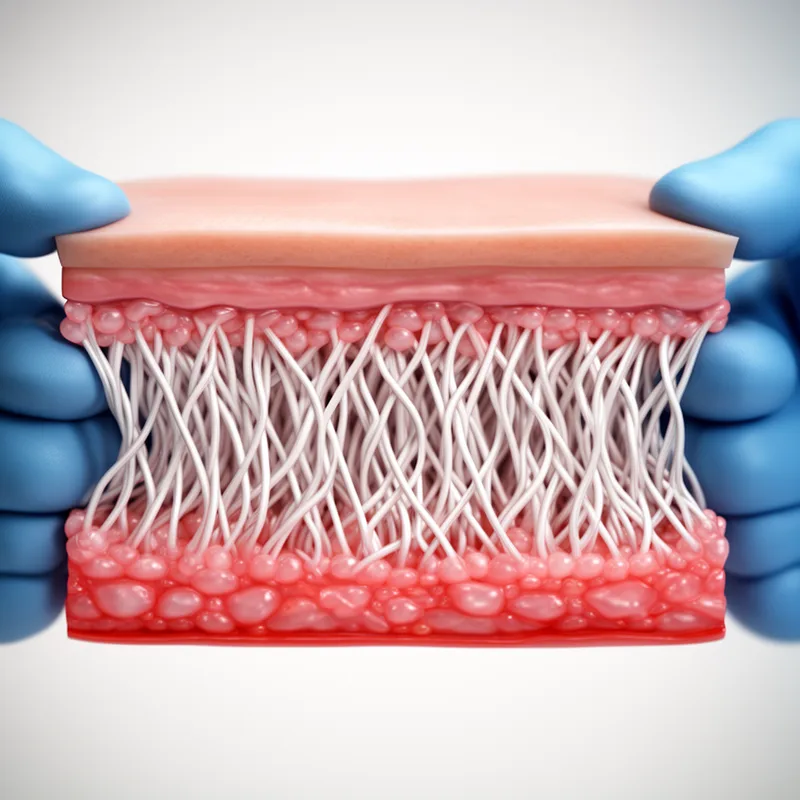
The skin's collagenous layers provide strength and elasticity.
-
In the laboratory, they observed how collagenous fibers contribute to the healing of wounds.
Synonyms

Relating to the strong protein that gives skin and tendons strength
Surface Forms
Morphology
Etymology
Collagenous comes from collagen, which comes from the old Greek word kolla meaning 'glue' and a part that means 'to make'. So collagenous (with the ending -ous meaning 'full of') describes tissue that is full of this glue-like protein, which is why collagenous fibers give strength and support.