
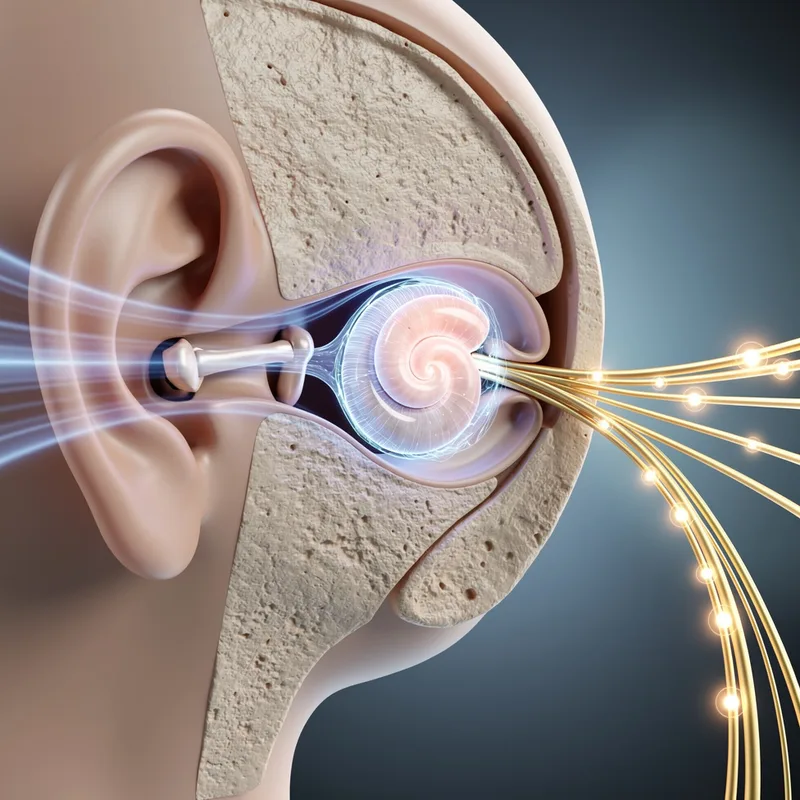
cochlea
 1
7.7
1
7.7

- noun
- /ˈkɑːkliə/
- Specialized
- Damage to the cochlea can lead to permanent hearing loss if the hair cells responsible for sensing sound vibrations are destroyed.
- cochlea and nerve
- cochlea and cochlear
- turn of the cochlea
Loading YouTube…
Watch on YouTubeAnd that's because within that little coiled thing we call the cochlea, you have all these tiny little, little, what are called hair cells.
- And that's because within that little coiled thing we call the cochlea, you have all these tiny little, little, what are called hair cells.
- Now, some people really like the artificial cochlea.
Examples
-
So here's this snail shaped organ, the cochlea, and they're arranged in sort of this spiral.
-
The two main parts of the inner ear are the semicircular canals and the cochlea.
Academic text (1990) -
And in other parts of the cochlea, the hearing is normal.
-
In order for the cochlea to perform its intended functions, a number of conditions must be present.
Academic text (1998) -
We begin to lose hair cells and areas of the cochlea become less responsive.
-
The sound pressure level of the high frequency can really damage your cochlea.
-
The reason for the severe loss in the basal turn of this cochlea is unclear.
Academic text (1998) -
Most cases of tinnitus are caused by disorders in the cochlea or auditory nerve.
Academic text (2005) -
The irreversibility of permanent hearing loss is a consequence of the cochlea's inability to repair or regenerate hair cells.
Academic text (2004) -
Basically, this implant transforms acoustic energy waveforms into electrical signals that stimulate the cochlea through electrodes.
Academic text (1995)
Compounds

- Specialized
A small opening that leads into the cochlea, the snail-shaped part of the inner ear
Surface Forms
Etymology
Cochlea comes from an old word kochlias meaning 'snail', because this part of the ear looks like a snail shell. That's why the cochlea is the spiral part of the inner ear that turns sound into nerve signals.