
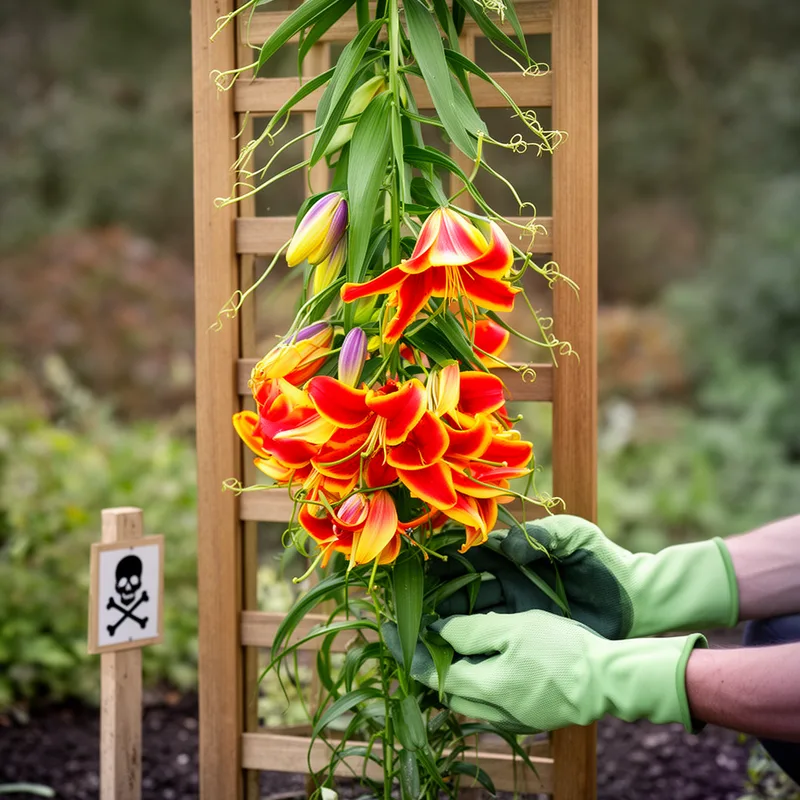
climbing lily
- noun
- /ˈklaɪmɪŋ ˈlɪli/
- UK
- All parts of the climbing lily are poisonous, so it's important to keep it away from pets and children.
Examples
-
We saw a climbing lily with striking red petals during our hike in the botanical reserve.
-
The climbing lily blooms beautifully in the summer.
-
The climbing lily adds vibrant color to gardens, but gardeners must handle it carefully due to its toxic parts.
-
Many gardeners love the climbing lily for its vibrant colors.
-
The climbing lily is known for its striking yellow and red flowers, making it a popular choice for ornamental gardens.
-
Due to its poisonous nature, the climbing lily should be planted in areas that are inaccessible to pets and young children.
-
In tropical regions, the climbing lily thrives in warm climates and adorns many gardens with its beautiful blooms.
Synonyms

A climbing plant with bright red and yellow flowers that has poisonous parts

A climbing tropical plant with bright red or yellow flowers that is poisonous

A climbing plant with bright red, yellow, or purple flowers that is poisonous

A climbing plant with bright red, yellow, or purple flowers and poisonous parts
Surface Forms
Morphology
The phrase is compositionally built from 'climbing' (from climb) modifying 'lily', so its basic meaning — a lily that climbs or is a climbing plant — is directly derivable from the constituents; the botanical details (genus, toxicity) are specialized extensions. This follows a common adjective+noun pattern found across languages, so a B1 learner who knows 'climb' and 'lily' would understand the MWE's core meaning.
Etymology
Climbing lily uses climbing to show how it grows and lily to show its showy flower. Its leaf tips act like little hooks so it can 'climb' up walls or other plants, which is why the name simply means a lily that climbs.

