
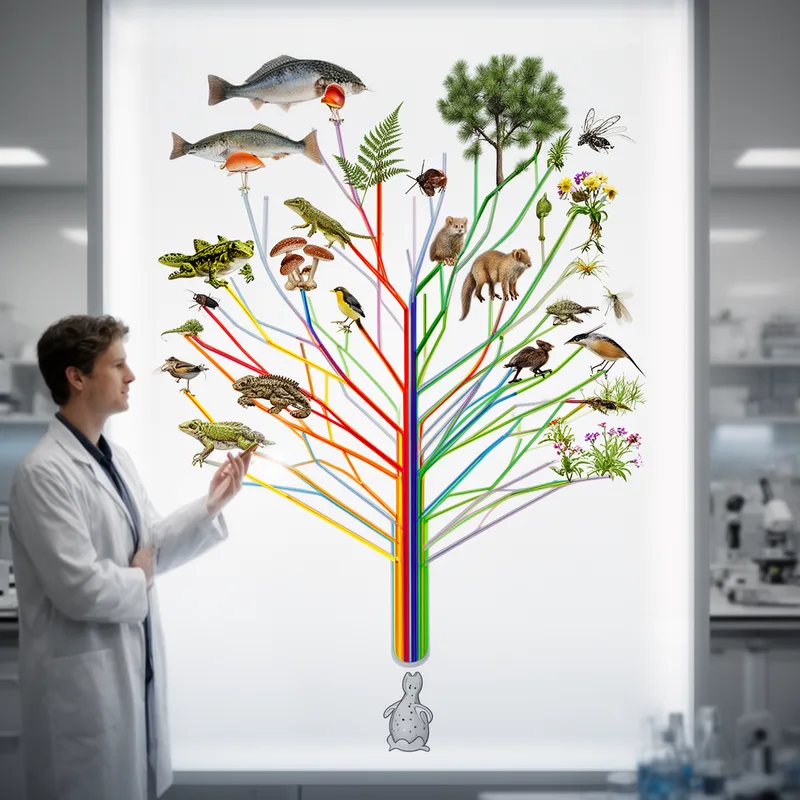
cladistic
- adjective
- /kləˈdɪstɪk/
- Specialized
- The cladistic classification of reptiles reveals important evolutionary links among various species.
Examples
-
Using a cladistic approach, scientists can trace the lineage of organisms based on shared ancestry.
-
It would be interesting to compare the relationships between these two species and other Mediterranean taxa using the cladistic approach, which may help to identify a common ancestor or clarify their evolution, and to evaluate other original hypotheses.
Blog text (27) -
The assumption of uniformitarianism about the social evolution of tribal societies has been addressed by Moore in his seminal article, "Putting Anthropology Back Together Again: The Ethnographic Critique of Cladistic Theory."
Academic text (2000) -
The researcher focused on the cladistic relationships between different bird species to better understand their evolution.
Synonyms
 3
9.9
3
9.9

About how kinds of animals and plants change and are related over time
Compounds

- Specialized
A method that groups species by their common ancestors using tree diagrams
Surface Forms
Morphology
cladistic = cladist (opaque) = clad + istic
'Cladist' is a specialized scientific term and not transparent to general English learners.
Etymology
The word cladistic comes from the Greek root clad- and the Greek word klados, both meaning 'branch'. So a cladistic approach groups animals and plants by their shared 'branches' on the tree of life, showing who is closely related.