
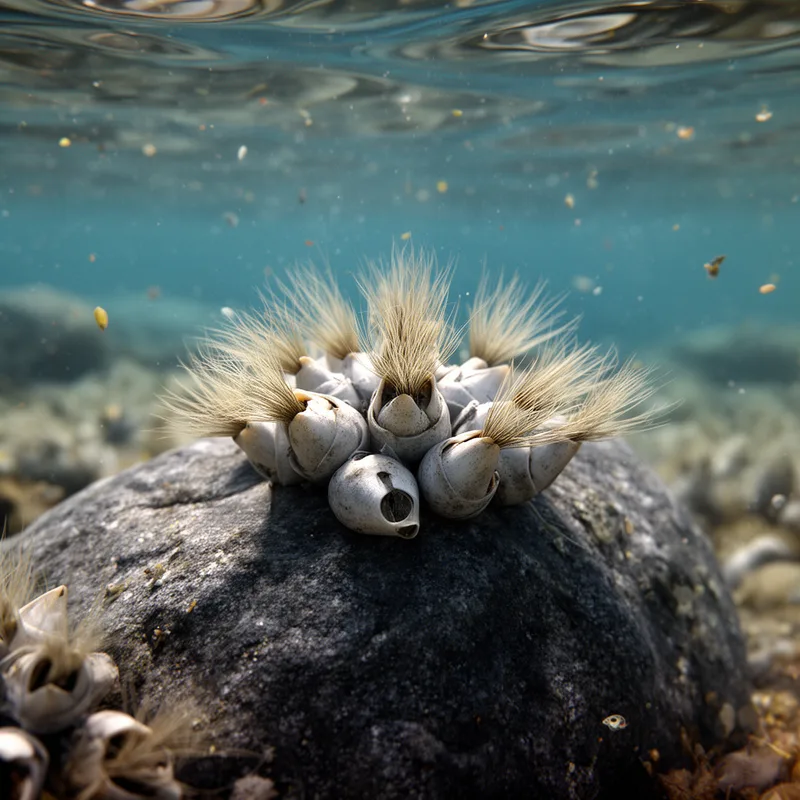
cirripede
- noun
- /ˈsɪrɪˌpiːd/
- Specialized
- By early May, his correspondence with scientists all over the world, primarily related to his work on cirripedes or barnacles, resumed in great detail.
Examples
-
Many cirripedes are found in tidal zones where they cling to hard surfaces.
-
The marine biologist studied the behavior of cirripedes in their natural habitat.
-
Cirripedes, commonly known as cirripedes, attach themselves to rocks and ships to filter feed on plankton.
Synonyms
 11
6.9
11
6.9

A small sea animal that sticks to rocks and the bottoms of boats and forms a hard shell

A small sea animal with a hard shell that attaches to rocks and feeds with feathery legs
Surface Forms
Morphology
cirripede = cirri + pede
The term is a learned scientific compound from Latin combining forms (cirri- + -pede) that are not recognizable as productive English morphemes to an average B1 learner, so its meaning is not transparently derived from common English base words.
Etymology
Cirripede comes from two parts: cirri meaning 'curl' or 'fringe' and ped meaning 'foot', the same 'ped' you see in pedal and pedestrian. That's why a cirripede, a barnacle, has feathery 'feet' called cirri that it uses to catch food while stuck to rocks or the sides of ships.