
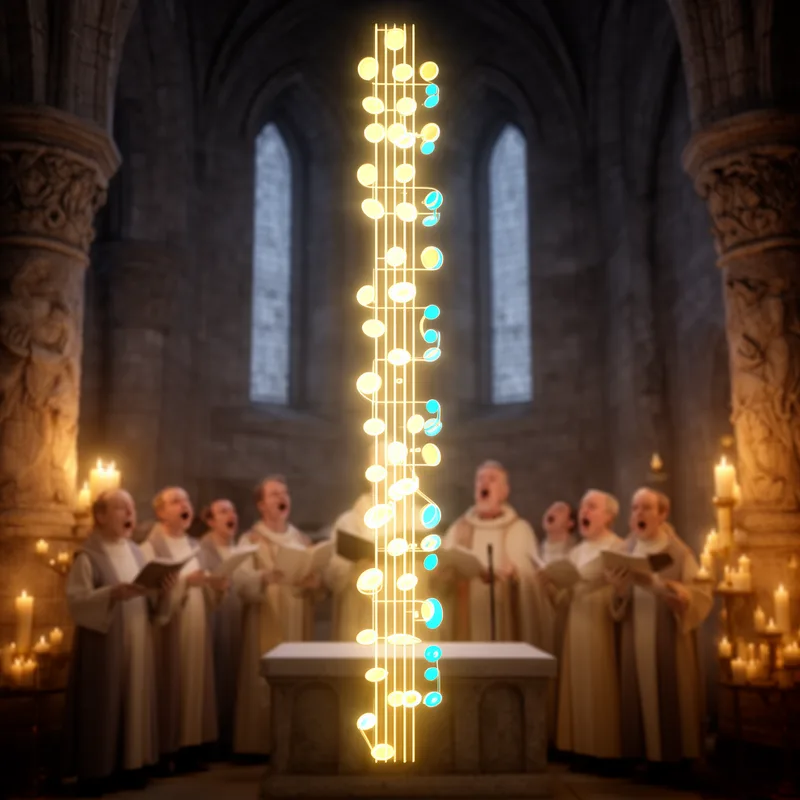
church mode
- noun
- /tʃɜrʧ moʊd/
- Specialized
- The melodic material begins with three tones (sol-mi-la), completes the major pentatonic, then diatonic major, and proceeds with examples in the various church modes.
Examples
-
Composers frequently used the church modes to create the melodic lines in early Western music.
-
Gregorian chant is often structured around specific church modes that define its unique sound.
-
@53 lakesidey and @52 R. Fife: Aeolian is also related to a musical church mode from the Middle Ages and classical Greek musical theory before that.
Blog text (4) -
Understanding the characteristics of each church mode is essential for performing traditional sacred music.
Synonyms
 10
7.0
10
7.0

A set of notes used to make a musical scale, like major or minor

A musical scale used in old church singing that gives chants a special sound

A pattern of notes that church singers use in medieval chant

A pattern of notes used in old Western music like Gregorian chant

A pattern of eight notes that gives a piece of Western music its typical sound
Surface Forms
Morphology
church + mode
The meaning is compositionally predictable: 'mode' (a type of musical scale) modified by 'church' clearly indicates a musical scale associated with church practice (e.g., Gregorian chant). Although the term is somewhat specialized, a B1 learner who knows both constituent words can infer it denotes the kinds of scales used in church music.
Etymology
Church mode comes from old church music, where singers used set patterns of notes for different chants and the word mode meant a musical 'way' or 'pattern' while church shows it was used in churches. So today church mode means a particular 'scale' or pattern of steps between notes that gives a melody its special character.