
chronotope


 1
9.9
- noun
- /ˈkrɒnəˌtoʊp/
- Literature
- The author's use of a rural chronotope enhances the sense of isolation in the story.
- Bakhtin's chronotope
- artistic chronotope
- idyllic chronotope
Examples
-
The reader is thus confronted with a multidimensional chronotope (n22): Florence, Lima, the Peruvian jungle, the past, and the present.
Academic text (1999) -
As we have seen, each film sets up an initial chronotope, which is interrupted as new forces enter its sphere.
Academic text (2010) -
What seems to be of importance, rather, is the chronotope of the city instead of this particular city itself.
Academic text (1999) -
His is a narrative of survival at the worst possible chronotope.
Academic text (1996) -
M. M. Bakhtin's concept of the chronotope can further facilitate our analysis:
Academic text (1990) -
Thus Bakhtin points out that "the importance of the chronotope of the road in literature is immense....
Academic text (1991) -
Second, the action of this chronotope is carried forward largely by means of conventional, sequential dialogue.
Academic text (1990) -
Therefore, the study of the chronotope is an important seismograph for registering this development.
Academic text (1999) -
In other words, a chronotope is a textual phenomenon that crystallizes action and the meaning of action.
Academic text (1999) -
Seven place/time units, or chronotopes, are each experienced differently by the reader.
Academic text (1990)
Surface Forms
Morphology
chronotope = chrono + topo
Although the word is historically built from classical elements meaning 'time' and 'place', those elements are not ordinary standalone English words and the literary-theory sense is specialized.
Etymology
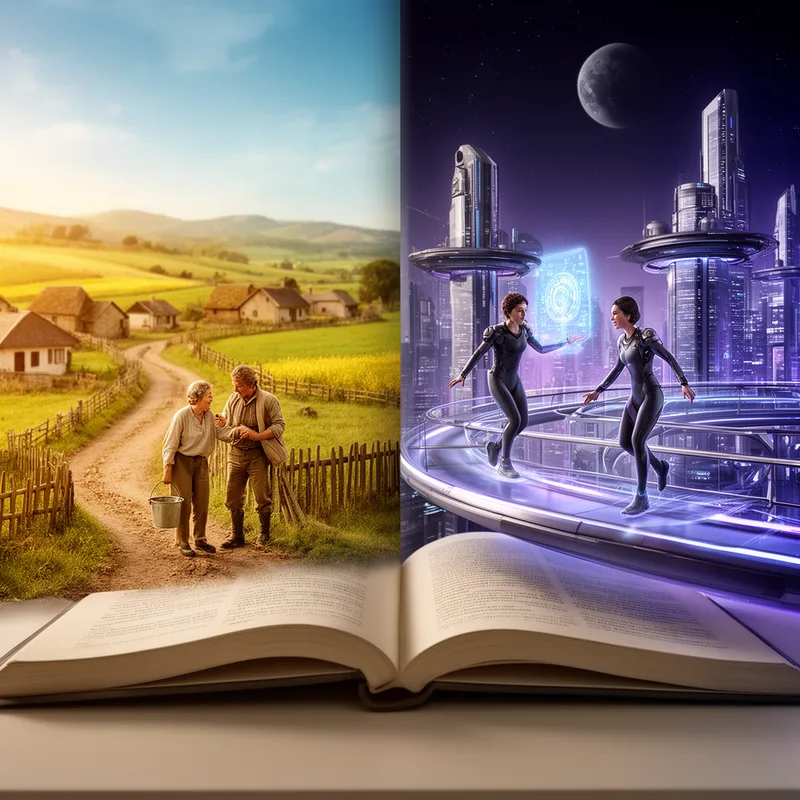
The word chronotope comes from Greek parts chron- 'time' and topos 'place'. So a chronotope is like a map where time and place meet in a story, showing how the setting and events shape each other.