
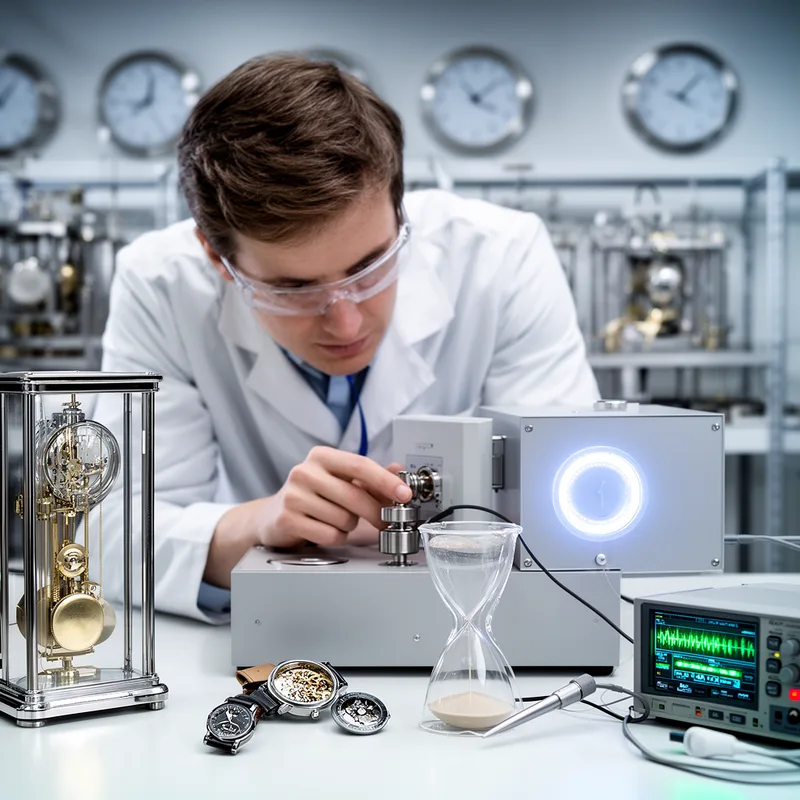
chronometry
- noun
- /krəˈnɑːmətri/
- Specialized
- The study of chronometry is essential for understanding historical events and timelines through accurate timekeeping.
Examples
-
Isotopic variations can establish a chronometry for when those events occurred.
Academic text (2005) -
Genette's principles of fabula chronometry do little to account for the narrative sense of time, not least because at bottom temporality and narrative are interdependent concepts.
Academic text (2001) -
In the field of chronometry, researchers strive to improve the accuracy of time measurements for various applications.
-
Chronometry involves the use of precise instruments to measure time accurately in scientific experiments.
Synonyms

 3
3.7
3
3.7

Measuring and recording how time passes on clocks or watches

 1
9.9
1
9.9
A study of time and the making of clocks and watches
 1
9.8
1
9.8
Recording time and events in order using calendars and clocks
How Precise

Surface Forms
Morphology
chronometry = chron (transparent) = chron + metry
The word 'chronometry' is derived from the combination of 'chron' and the suffix 'metry', indicating the science of measuring time.
Etymology
Chronometry comes from the Greek chronos meaning 'time' and the ending -metry meaning 'measure', so you can imagine it as a 'time meter'. That's why chronometry is the careful science of measuring time accurately, using very precise clocks.