
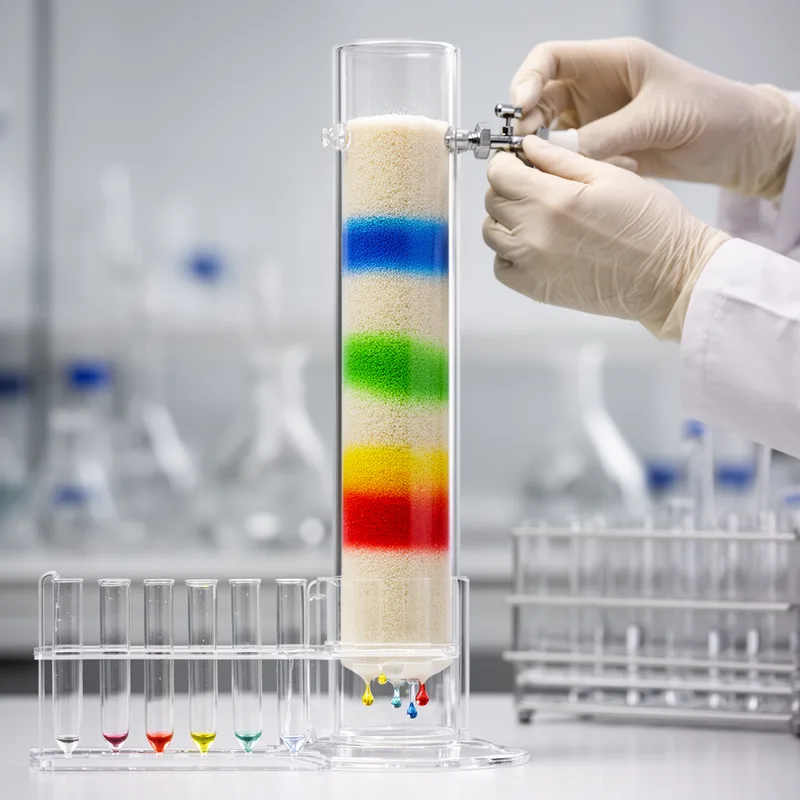
chromatographic


 1
8.4
- adjective
- /ˌkroʊməˈtɒɡrəfɪk/
- Specialized
- In the laboratory, we used a chromatographic technique to isolate the pigments in the leaves.
- chromatographic separation
- chromatographic profile
- chromatographic analysis
Examples
-
Two different mobile phases (named here as A and B) were used for the chromatographic separation of 90Sr, 241Am, and Pu isotopes.
Academic text (2018) -
Furthermore, chromatographic methods, as well as tandem MS experiments, have provided means to distinguish highly complex isomeric glycans, a determinant step to establish accurate structure-function relationships.
Academic text (2016) -
Using GC-MS, the content of the seeds was not identified as no chromatographic peaks were observed.
Academic text (2016) -
Graph: Figure 1 Chromatographic Profiles of Sterols in Selected Feces
Academic text (2006) -
PHOTO (COLOR): Research technician John McEwen prepares fruits and vegetables for the chromatographic separation of antioxidant components.
Academic text (1996) -
Chromatographic analysis of DEHP diffusion in saliva in vivo for 30 minutes indicated a diffusion value of 1.51 g/cm.
Academic text (2008) -
To overcome the challenge, recent efforts have been focused on the use of radionuclide selective extraction chromatographic cartridges for sequential separation and determination of 90Sr and actinides in a urine sample.
Academic text (2018) -
The chromatographic method allowed scientists to separate and analyze the different substances in the sample.
-
Chromatographic analysis revealed several key compounds in the mixture that were previously unidentified.
Synonyms
Relating to a method that separates mixtures, like pigments from a liquid
Surface Forms
Morphology
chromatographic = chromatography (transparent) = chromatograph + ic
The adjective is a direct derivation from the noun 'chromatography' with the productive suffix '-ic' meaning 'relating to', so the meaning is clear to learners who know the base term.
Etymology
Chromatographic comes from the Greek parts chroma 'color' and graph 'write'. Early scientists used the method to make the parts of a mixture appear as colored bands on paper, like 'writing' with colors, so chromatographic now means a way to separate and show a mixture's parts.