
chondrule
 1
9.9

- noun
- /ˈkɒndrul/
- Specialized
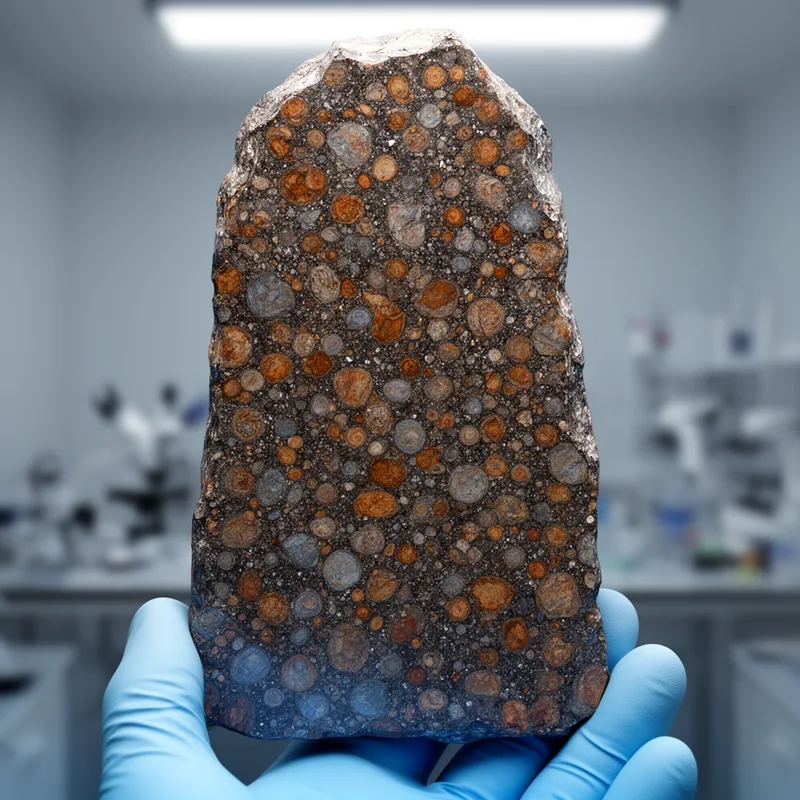
- An Allende stony-chondrite displays roundish chondrules.
- meteorite with chondrules
Examples
-
If you want a meteorite with chondrules, seek out certain types of stony chondrites.
Academic text (2001) -
Take your time, look for fresh black fusion crust, and remember that type 3 has the most pristine chondrules.
Academic text (2001) -
Type 6 may still show chondrules, but they are far fewer in number and less well preserved.
Academic text (2001) -
If you want a meteorite with chondrules, Types 3 and 4 are the most desirable.
Academic text (2001) -
These smaller objects did not contain enough radioactive elements to generate much heat, so their chondrules remained intact.
Academic text (2001) -
Specimens are grouped to show the effects of increasing thermal alteration and shock, as well as variations in chondrule size and type.
Blog text (20) -
The chondrules surrounded a mixture of ices, which also mortared them together.
Fiction book (2001) -
Dating of the chondrules, based primarily on the radioactive uranium they contain, has identified chondrites as old as 4.6 billion years, far older than any other rocks on Earth or the Moon.
Academic text (2003) -
Scientists are still debating the origin of chondrules—seed-sized droplets that are embedded inside certain stony meteorites.
Academic text (2001) -
Researchers discovered a tiny chondrule preserved in a stony meteorite that formed billions of years ago.
Synonyms

 1
7.7
A small round lump of mineral that forms in rock or mud
Surface Forms
Morphology
chondrule = chondr + ule
The word is built from a technical combining form ('chondr-') plus a diminutive suffix ('-ule'); these are not recognizable standalone English bases for average learners, so the meaning is not inferable from common English vocabulary.
Etymology
Chondrule comes from the Greek root chondros meaning 'grain' and the small ending -ule meaning 'little'. So a chondrule is literally a 'small grain', which is why the word names the tiny, rounded mineral beads found in some meteorites.