
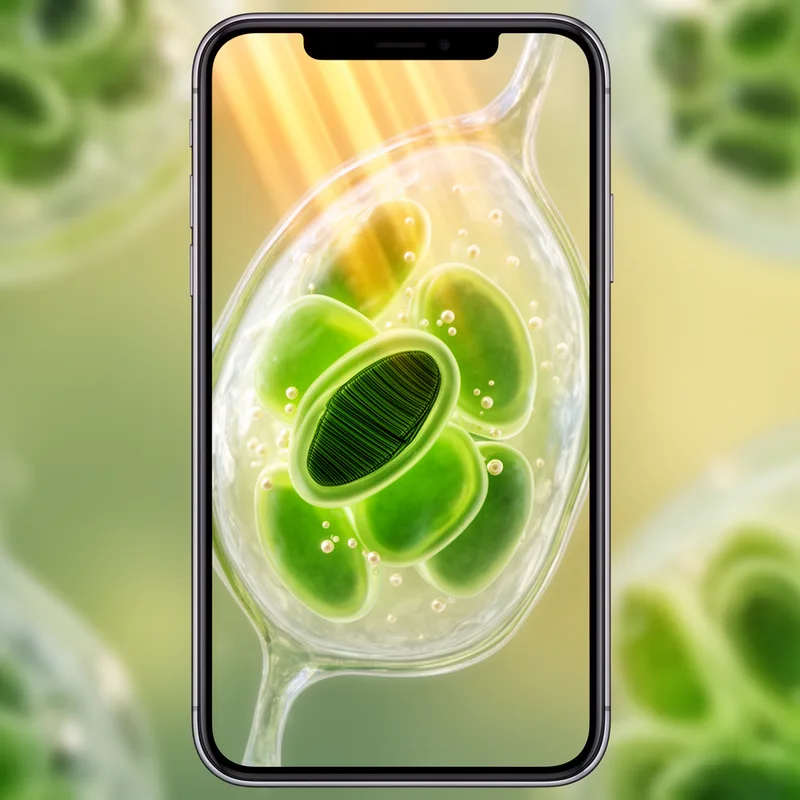
chloroplast
 2
5.6

- noun
- /ˈklɔːrəˌplæst/
- Specialized
- Yellow, orange, or red pigmentation, as seen in oranges and tomatoes, arises from the conversion of chloroplasts to chromoplasts.
- chloroplasts and mitochondria
- grana within chloroplasts
- chloroplasts in cells
Loading YouTube…
Watch on YouTubePlants have a an extra small circular chromosome because they also have one in the chloroplasts and the other types of plastids.
- Plants have a an extra small circular chromosome because they also have one in the chloroplasts and the other types of plastids.
- But then think about a chloroplast, for instance, over like one of the photosynthetic organelles inside of the, the, the cells.
Examples
-
In plants, there is something called a chloroplast that again is involved in energy production.
-
Apparently, light absorbed by the plants exceeded the photo-utilization capacity in chloroplasts.
Academic text (2015) -
And then here in the stroma of the chloroplast is where we're doing the dark reactions.
-
Over 40 years ago, DNA was discovered in chloroplasts and mitochondria.
Academic text (2003) -
These genes have been shown to be essential for chloroplast division in both mosses and Arabidopsis thaliana.
Academic text (2018) -
Considerable evidence indicates that the structural properties of leaves (apart from changes in chloroplasts) may influence photosynthetic performance.
Academic text (1997) -
Stomatal guard cells (with chloroplasts) will receive less intense light on a curved surface.
Academic text (1997) -
The chloroplast is where the green pigment chlorophyll captures light for photosynthesis.
-
Chloroplasts are essential for photosynthesis, allowing plants to convert sunlight into energy.
-
In algae, chloroplasts play a crucial role in synthesizing food from sunlight during photosynthesis.
Surface Forms
Morphology
chloroplast = chloro + plast (semi-transparent) = chloro + plast
The combining forms hint at 'green' + 'formed body', which partially indicates the organelle's nature, but both elements are specialized scientific morphemes not familiar to average B1 learners.
Etymology
Chloroplast comes from the parts chloro- 'green' and -plast 'formed part', the same root seen in plastic. So chloroplasts are the green parts of plant cells that hold chlorophyll and turn sunlight into food.