
chlorine dioxide
- noun
- /klɔːˈriːn daɪˈɒksaɪd/
- Specialized
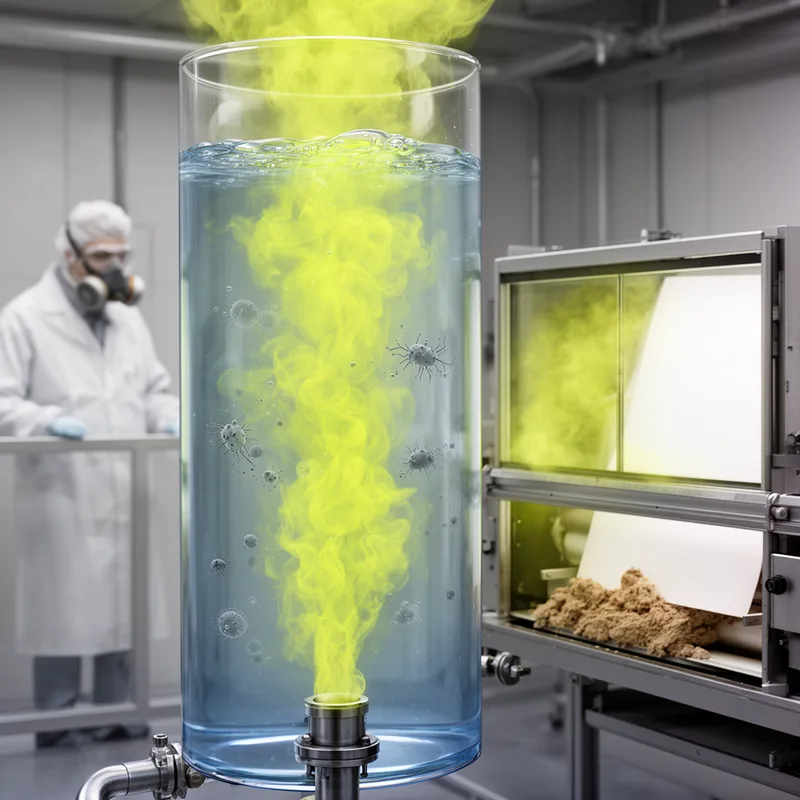
- In industrial applications, chlorine dioxide is frequently utilized for bleaching paper and textiles.
- residual chlorine dioxide
- chlorine dioxide concentration
- oxidation of chlorine dioxide
Examples
-
The selectivity and oxidation capacity of chlorine dioxide make it a stronger oxidative disinfectant than chlorine.
Academic text (2002) -
Chlorine dioxide possesses several chemical traits that make it perform well as a disinfectant.
Academic text (2002) -
The three methods used to produce chlorine dioxide are summarized in Table 2.
Academic text (2002) -
New methods offer the ability to produce controlled quantities of chlorine dioxide at safe concentrations with less equipment.
Academic text (2002) -
Automated analysis of chlorine dioxide at concentrations found in potable water is a developing technology.
Academic text (2002) -
On-site generation is the only economically viable method to implement chlorine dioxide.
Academic text (2002) -
Difficulties have been encountered in maintaining an adequate chlorine dioxide residual in the hot water system.
Academic text (2002) -
Adequate chlorine dioxide residuals can be maintained in the main distribution system and at cold water distal sites.
Academic text (2002) -
The system was evaluated during an ongoing field study to analyze the effectiveness of chlorine dioxide for control of Legionella.
Academic text (2002) -
Current generation methods involve the oxidation of sodium chlorite to chlorine dioxide and various byproducts.
Academic text (2002)
Surface Forms
Morphology
The term is a straightforward chemical compound name formed from 'chlorine' + 'dioxide' and therefore denotes the dioxide of chlorine (a chlorine oxide gas). This follows a transparent, cross-linguistic naming pattern (e.g., 'carbon dioxide'), so a B1 learner who knows the constituents can infer it refers to a chlorine-containing oxide gas used for bleaching/disinfection.
Etymology
Chlorine dioxide literally tells the story: chlorine (a strong cleaner) plus dioxide (two oxygen atoms) make a yellow-green gas that attacks stains and germs. So, because this gas removes color and kills germs, it is used to 'bleach' paper and 'disinfect' water.

