
chicory plant
- noun
- /ˈʧɪkəri plænt/
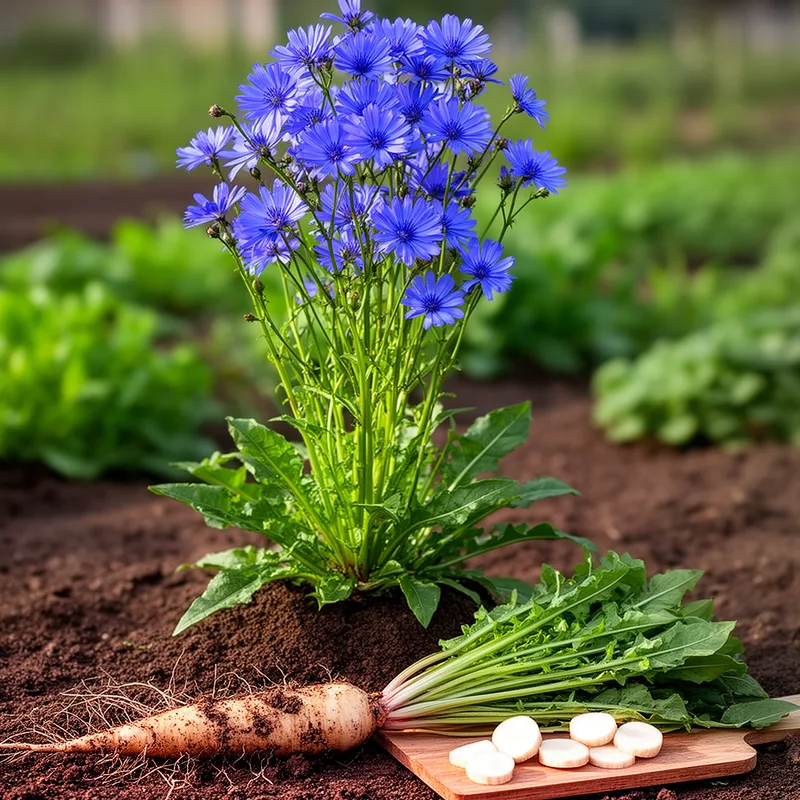
- Gardeners enjoy growing the chicory plant for its vibrant blue flowers and edible leaves.
Examples
-
The chicory plant is often used as a coffee substitute due to its flavorful roots.
-
Fresh leaves from the chicory plant add a pleasantly bitter flavor to salads.
-
The chicory plant blooms beautifully in the summer.
-
I love adding chicory plants to my salads.
-
Fresh leaves from the chicory plant add a pleasantly bitter flavor to salads.
-
Gardeners enjoy growing the chicory plant for its vibrant blue flowers and edible leaves.
-
The chicory plant is often used as a coffee substitute due to its flavorful roots.
Synonyms

 2
6.5
2
6.5

A plant with blue flowers, bitter leaves, and an edible root

A plant with blue flowers grown for its roots and leaves that people eat

A plant with blue flowers grown for its edible leaves and root

A plant from southern Europe with flat blue flowers and dark centers called chicory
How Edible

Surface Forms
Morphology
The phrase simply denotes a plant of the type 'chicory' and its meaning is directly composed from 'chicory' (a bitter-leaved salad plant) + 'plant' (a photosynthetic organism). This straightforward noun–noun construction is compositional and cross-linguistically common, so a B1 learner who knows both constituents will understand it.
Etymology
Chicory plant may come from an old Greek word for a 'bitter herb'. People long ago ate its bitter leaves in salads and roasted its roots as a 'coffee substitute', so the name came to mean the plant with bright blue flowers, edible leaves, and flavorful roots.