
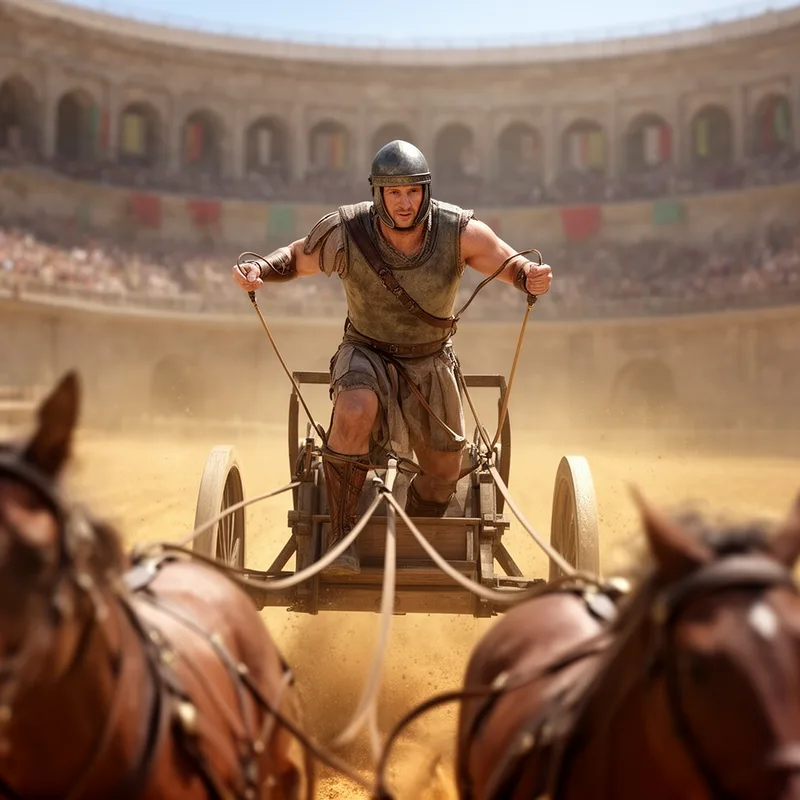
charioteer
 1
9.9
1
9.9

- noun
- /ˌʃɛrɪəˈtɪr/
- In ancient Rome, a charioteer often competed in dangerous races for glory and rewards.
- victorious charioteer
Loading YouTube…
Watch on YouTubeBut in this feverish pursuit, the charioteer loses control.
- But in this feverish pursuit, the charioteer loses control.
- And he says that the soul can be looked at as a union of powers in a team of winged steeds and a winged charioteer, right?
- Crab bind crab damage the hands, feet, sinews of the horses and charioteers of the blue colors.
- Anyways, but instincts and then the other horse represents emotions and then the charioteer represents rationality, which controls, you know, the two beasts, right?
- Tishtree, the the Armenian charioteer takes the men that she wants even though she is also a vampire and has has been with him.
Examples
-
Even the most famous of the charioteers has to give way to me.
-
You all know him as the finest charioteer in Rome.
-
But in this feverish pursuit, the charioteer loses control.
-
I own some of the best gladiators and charioteers in Rome.
-
Greek charioteers wore short paneled skirts.
-
And he says that the soul can be looked at as a union of powers in a team of winged steeds and a winged charioteer, right?
-
Mother and Father Addams have been depicted as a god and a goddess, charioteers driving their steeds to the netherworld.
Fiction book (1991) -
A Roman-era curse tablet found at Carthage, for example, calls on demons to bind every limb and every sinew of Victoricus, the charioteer of the Blue team, and of the horses he is about to race.
Academic text (2003) -
The skilled charioteer deftly maneuvered his chariot around the turn, thrilling the crowd.
-
The young charioteer trained tirelessly to master the art of driving at high speeds during the games.
Synonyms
 53
5.8
53
5.8
A person who guides animals that pull a carriage or wagon
Surface Forms
Morphology
Etymology
Charioteer comes from chariot, a small two-wheeled cart used in war or in races, plus the ending -eer, which means 'a person who does something'. So a charioteer is literally someone who 'drives' a chariot, like a modern car driver, which explains why it means a person who drives a chariot in ancient times or races.