

ceramic ware
- noun
- /səˈræmɪk wɛr/
- For our picnic, we packed sturdy ceramic ware that would not easily break while transporting food and drinks.
Examples
-
Cave and cliff dwellers may have changed the properties of a cave or cliff to more readily meet their needs or perhaps added a fire pit to generate warmth, roast food, or fire ceramic wares, but their impact was probably minimal.
Academic text (2010) -
It is largely Yungur women who make the fired clay wiiso, along with a range of domestic and ritual ceramic wares (see Berns 1986:259-61).
Academic text (1990) -
In the lots located just north of the hotel, the Wayne State team uncovered privies and trash pits containing nearly whole pieces of ceramic ware.
Academic text (2011) -
De Heusch (quoted in Herbert 1993:213) describes in detail Thonga rituals of birth that see the child "as the product of successful firing," a piece of ceramic ware that has been fired and not cracked.
Academic text (2007) -
Conversely, traditional female activities were accentuated by the trade, including the preparation of deerskins, the manufacture of clothing, and the continued reliance on native pottery as opposed to imported ceramic ware.
Academic text (1990) -
Ingestion of lead through food is becoming less common, but it continues to occur through food being grown in contaminated areas, stored in lead-soldered cans (in 1989, only 1.4 percent of domestic cans contained lead in solder) or poorly fired ceramic ware.
Academic text (1993) -
The dining room was beautifully set with elegant ceramic ware, including plates and bowls adorned with intricate patterns.
-
She admired the ceramic ware displayed in the gallery, each piece showcasing the unique craftsmanship of local artisans.
Synonyms

 76
3.6
76
3.6

Delicate, high-quality dishes made of porcelain for special occasions
 24
2.3
24
2.3
Objects made from clay and hardened by heat like pots and bowls
 3
6.6
3
6.6
Pottery made from clay and baked at low heat, often with a shiny layer
 2
5.1
2
5.1
A strong type of pottery made from clay and fired very hot so it does not take in water
 1
2.8
1
2.8
Plates, bowls, and cups used for serving and eating food


 1
4.9
1
4.9
Dishes and cups made from fine porcelain used at the table
 1
9.9
1
9.9
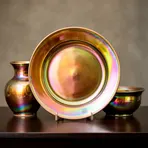
Pottery with a shiny, rainbow-like metal coating

People use plates, bowls, and cups to serve food

Objects made from clay and baked until hard, like pots and bowls
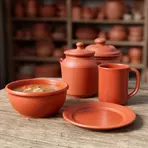
Pottery made from red clay and baked at low heat for everyday dishes

Pottery decorated with liquid clay before firing
How Durable

Surface Forms
Morphology
The meaning 'articles made from ceramic' is directly compositional from 'ceramic' (made of ceramic material) + 'ware' (items or goods), following the common ADJ + ware pattern that denotes products of a material. This is a predictable, cross-linguistic compounding pattern, so a B1 learner who knows both constituents would readily infer the meaning.
Etymology
Ceramic ware comes from pottery: ceramic is clay that a potter shapes and makes hard in a very hot oven, and ware means 'goods' or items for the home. So the phrase pictures plates, cups and bowls made from that hard clay, which is why it means 'objects like plates and cups made from ceramic materials'.