
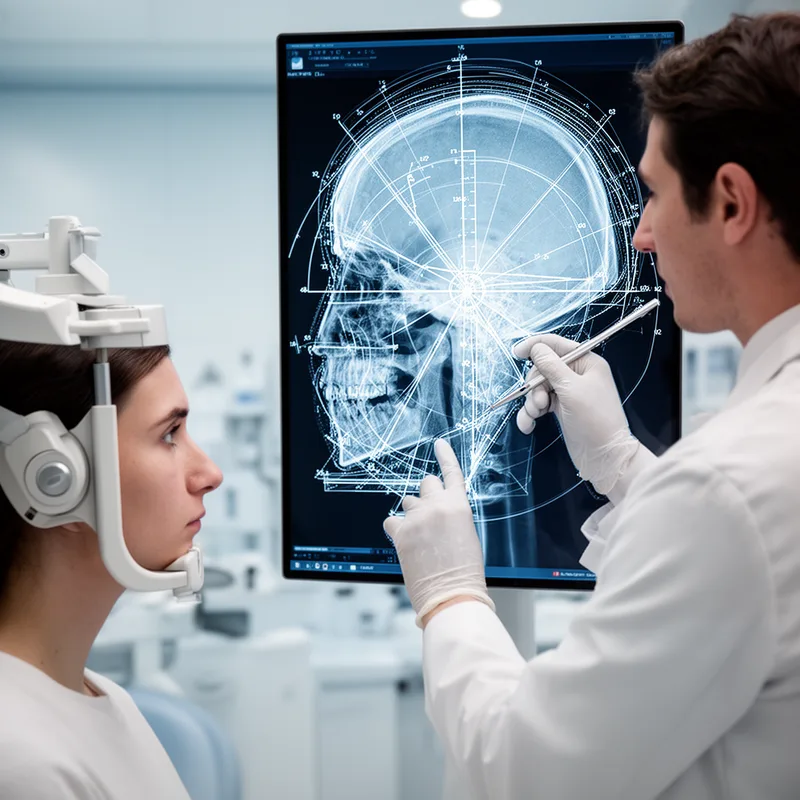
cephalometry
- noun
- /sɛfəˈlɑːmətri/
- Specialized
 :
cefalometría
:
cefalometría
- Doctors use cephalometry to assess head size in relation to developmental standards in children.
Examples
-
Anthropometry can be subdivided into somatometry, including cephalometry, and osteometry, including craniometry.
Academic text (2007) -
The significance and importance of somatometry, cephalometry, craniometry, and osteometry in the identification of human remains have been described, and a new term 'forensic anthropometry' has been coined.
Academic text (2007) -
Cephalometry
Academic text (1999) -
The cephalometry used in the study helped researchers analyze the head measurements of children.
-
Research in anthropology frequently employs cephalometry to understand human evolution and variation.
Synonyms


 1
9.9
1
9.9
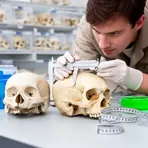
Measuring skulls to learn about people or animals
Surface Forms
Morphology
cephalometry = cephalo- (semi-transparent) = cephal + metry
The suffix '-metry' clearly indicates 'measurement', but the combining form 'cephalo-' (head) is a technical form not familiar to many learners, so the overall structure is only partially transparent.
Etymology
The word cephalometry comes from the Greek parts cephal- 'head' and -metry 'measure', the same -metry you see in geometry. So, cephalometry literally means 'measuring the head' and is used by doctors and researchers to measure head size and shape for medicine and the study of people.