
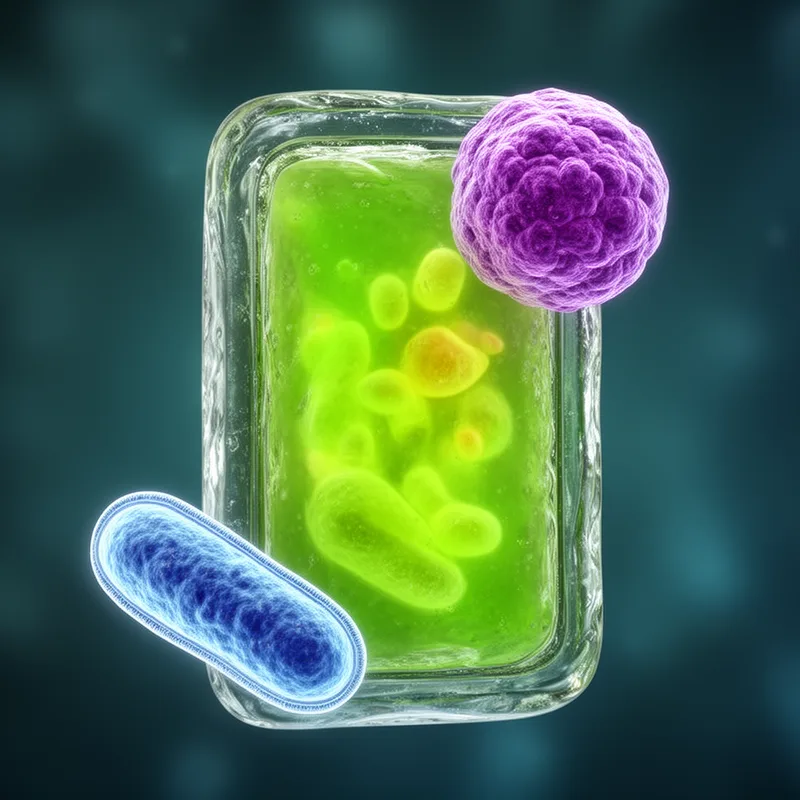
cell wall
 5
3.6
5
3.6

- noun
- /sɛl wɔl/
- Specialized
- They can't break down the cellulose cell wall of the grass they eat or the plants they eat without the fungi in their gut that do it for them.
- fungal cell wall
- mycobacterial cell wall
- cell wall components
Loading YouTube…
Watch on YouTubeIt's only for the fact that plants have cell walls, living cell walls that are filled with water.
- It's only for the fact that plants have cell walls, living cell walls that are filled with water.
- Plants don't have bones, They have cell walls.
- But bacteria do have cell walls, So one way that antibiotics work is to destabilize the cell wall.
- When you contract your muscles, it sends this cascade down into that cell and this little transporter translocates to the cell wall and acts as this gateway.
- Plant viruses also the plant cell wall would be very hard to get across with a by binding a protein.
- They're they have cell walls made out of Titan, which is the same structure found in insects, exoskeletons and crab shells.
- Or it could be there are cell walls which might be dead.
Examples
-
Because what calcium does is calcium works with the plant to strengthen the cell walls of the plant.
-
Their Hardy spores sport thick cell walls that allow them to survive extreme temperatures.
-
We're going to look at the cell wall, OK?
-
The cell wall is thick.
-
So the cell wall has this fiber reinforced structure.
-
So the bacterium is using a rigid cell wall to protect itself from the influx of water.
-
As tomatoes ripen, their cell walls go through several changes generated by many enzymes.
Academic text (1998) -
Endotoxin is a structural component found in the outer cell wall of Gram-negative bacteria.
Academic text (2004) -
Mycobacteria are slow-growing aerobic bacteria that have thick, wax-like, almost impenetrable cell walls.
Academic text (2005) -
The cell wall provides structural support and protection to plant cells.
Surface Forms
Morphology
The compound 'cell wall' is compositionally transparent: it denotes a 'wall' associated with a 'cell', so a B1 learner who knows 'cell' and 'wall' can infer a rigid layer surrounding the cell that provides structural support and protection. This formation is cross-linguistically common (e.g., French 'paroi cellulaire', Spanish 'pared celular') and follows standard noun+noun composition rather than an idiomatic shift, so it is readily predictable.
Etymology
Cell wall comes from the simple image of a wall around a cell. Like a house wall that gives shape and keeps things out, the cell wall is a hard outer layer around plants, fungi, and some bacteria, so it gives 'support' and 'protection' and helps keep the cell's shape.