

celestial longitude
- noun
- /səˈlɛstʃəl ˈlɒŋɪtud/
- Specialized
- Astronomers use celestial longitude to determine the position of stars in the night sky.
Examples
-
The coordinates are celestial coordinates; right ascension is the celestial longitude and declination is the celestial latitude.
Academic text (1990) -
To locate a star, you need to know its celestial longitude and declination.
-
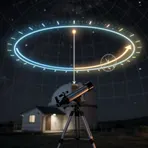
Celestial longitude is measured eastward from the vernal equinox along the celestial equator.
Synonyms

 17
9.8
17
9.8

The position of a star measured east along the sky's equator from the vernal equinox in hours, minutes and seconds
 3
9.4
3
9.4
An object's eastward angle along the sky's equator used to find its position, shown in hours
Surface Forms
Morphology
The phrase combines 'celestial' (relating to stars/planets) with 'longitude' (an east/west positional measurement), so its meaning as the longitude measured on the celestial sphere is directly inferable from the parts. Although the full technical definition (e.g. reference to the vernal equinox) is specialist, a B1 learner who knows both constituents will understand it denotes an angular eastward position of a celestial object.
Etymology
Celestial longitude combines celestial (meaning the sky) with longitude (the lines we use to find places on Earth). Imagine those longitude lines lifted into the sky and measuring how far east a star or planet is from the Sun's place at the 'start of spring', so the phrase tells you a body's eastward position on the sky.