
catadioptric


 1
9.9
- adjective
- /ˌkætəˈdaɪəptrɪk/
- Specialized
- Many photographers prefer a catadioptric lens for its ability to capture sharp images with minimal distortion.
- catadioptric lens
- catadioptric designs
Examples
-
Catadioptric lens designs bear no resemblance to any other photographic lens.
Academic text (1994) -
The light from the scanning mirror is reflected into a Newtonian, catadioptric telescope system with a primary mirror and a lens to correct aberrations.
Academic text (2000) -
Large images can also be produced by the lighter and more compact catadioptric or mirror lenses, which will be covered later.
Academic text (1994) -
DIAGRAMS: Catadioptric Lenses: Early and Still Basic Designs
Academic text (1994) -
Catadioptric lenses
Academic text (1994) -
A second refractive material may also be useful in catadioptric designs to reduce the design constraints imposed by a single refractive material.
Academic text (2001) -
Catadioptric lenses have several of the same problems in use as do the very long focal-length all-glass lenses.
Academic text (1994) -
Their optics are catadioptric, including a partial reflector, a full reflector, and refractive elements.
Academic text (2001) -
Proposed designs for catadioptric exposure systems use an off-axis optical system, a central obscuration optical system, or a polarizing beamsplitter cube configuration.
Academic text (2001) -
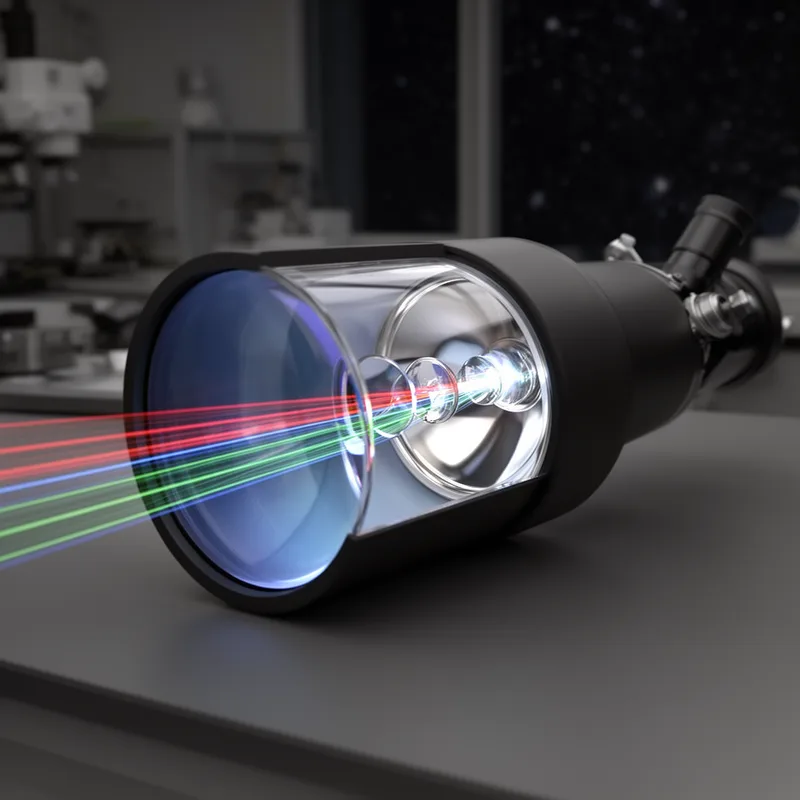
A catadioptric telescope combines both mirrors and lenses, making it easier to focus light for clearer distant views.
Surface Forms
Morphology
Etymology
Catadioptric comes from Greek parts catoptr- 'mirror' and dioptr- 'to see through or bend light', so it literally names systems that use both mirrors and lenses to direct and focus light.