
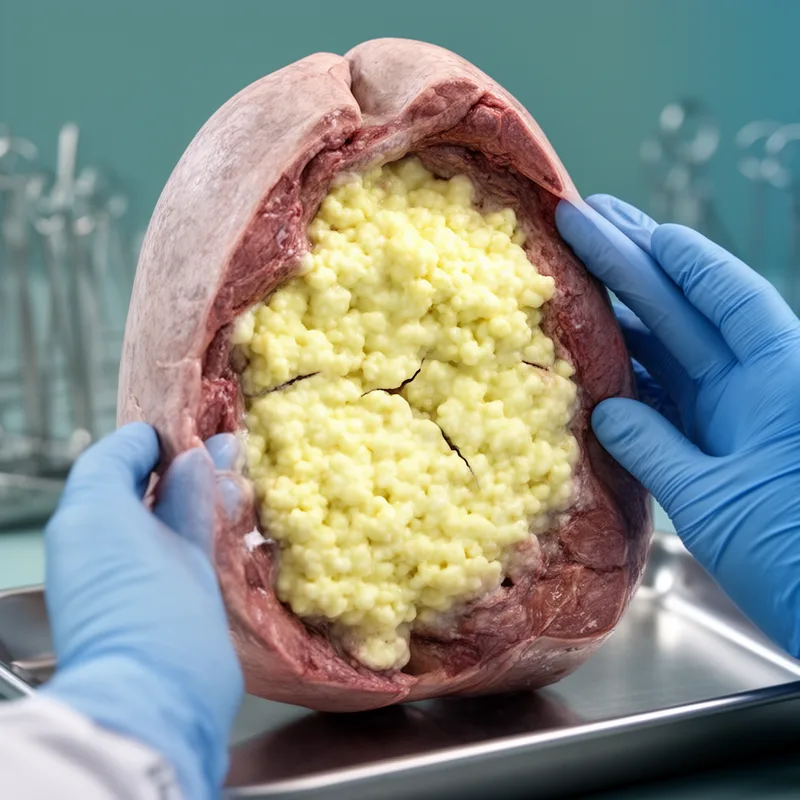
caseous


 1
9.9
- adjective
- /ˈkeɪʃəs/
- Specialized
- Histopathology revealed that the mass contained granulomas with caseous necrosis as well as Langhans' giant cells and numerous epithelioid cells.
- caseous necrosis
- caseous material
Examples
-
Instead, it showed caseous necrosis, which was followed by a positive culture and a positive tuberculin test.
Academic text (2006) -
In patients with tuberculosis, the lung tissue often exhibits a caseous appearance, resembling thick cheese.
-
The lesions then become necrotic, caseous disease develops.
-
The necrotic, caseous material was composed of a compact, friable mass.
Academic text (1996) -
A large area of caseous necrosis was surrounded by a histiocytic mantle.
Academic text (2002) -
Corynebacterium ulcerans may cause diphtheria in humans and caseous lymphadenitis in animals.
Academic text (2014) -
Histopathologic examination of the involved middle ear and mastoid mucosa will show three types of changes: miliary, granulomatous, and caseous.
Academic text (2002) -
The military type is associated with superficial infection, the granulomatous type with superficial bony involvement, and the caseous type with massive necrosis and sequestration.
Academic text (2002) -
Figure 2. Pseudotuberculosis-like caseous abscesses caused by Corynebacterium ulcerans in wild boar S28/3/13. Scale is shown in millimeters.
Academic text (2014) -
Moreover, C. ulcerans and C. pseudotuberculosis may produce phospholipase D, the major virulence factor involved in caseous lymphadenitis, which is a disease that mainly affects sheep, goats, and horses (3).
Academic text (2014)
Antonyms


Surface Forms
Morphology
caseous = case + ous
The adjective is a specialist medical term built from a Latin combining form meaning 'cheese-like' rather than from the common English word 'case', so learners cannot reliably infer its meaning from familiar vocabulary.
Etymology
The word caseous comes from the Latin caseus 'cheese', and this connection to the English word cheese makes it easy to remember. It describes tissue that looks or feels like 'cheese' when damaged by certain diseases.