

carrick bend
- noun
- Specialized
- To secure the towline, the crew tied a carrick bend between the two ropes.
Examples
-
The carrick bend is often used by sailors when they need to join two heavy hawsers.
-
He practiced tying a perfect carrick bend for his seamanship exam.
-
The sailor tied a carrick bend to join the two ropes.
-
Have you ever used a carrick bend before?
-
The carrick bend is a reliable way to connect two thick ropes on a ship.
-
Sailors often use a carrick bend to securely join heavy hawsers during towing.
-
For safety, the crew made sure to tie a carrick bend when securing the anchors.
Synonyms


 1
6.1
1
6.1
A way of tying two fishing lines together so they hold well
 1
8.6
1
8.6
A knot people who fish use to join two lines by wrapping the ends together

A strong knot for joining the ends of two thick ropes

A strong knot for joining two fishing lines by wrapping their ends
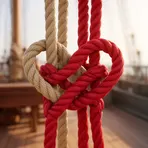
A way of joining two ropes used as a symbol of love

A knot used to join the ends of two ropes so they stay together
How Secure
- Specialized

- Specialized
1
6.1
- Jargon
1
8.4
- Specialized
1
8.5
Surface Forms
Morphology
carrick + bend
The element 'carrick' is not a transparent lexical item for most learners and carries no predictable meaning, while 'bend' in this phrase uses a specialized nautical sense ('a type of knot') that a B1 learner who only knows 'bend' as 'curve' would not infer. Because the overall sense is jargon-specific and not compositionally derivable from the known common meanings of the parts, it is opaque to learners.
Etymology
Carrick bend may come from a place called Carrick, where sailors often used this knot to join heavy ropes. The word bend here means 'knot that joins two ropes', so the name is a simple picture of a knot used to join ropes.