
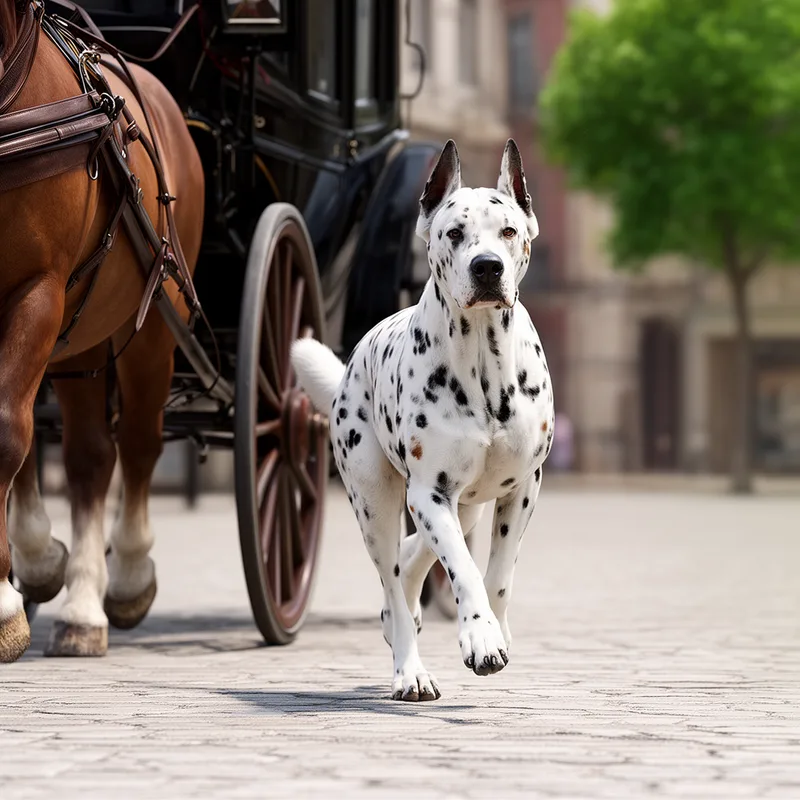
carriage dog
- noun
- /ˈkɛrɪdʒ dɔɡ/
- Archaic
- The carriage dog was historically used to trot alongside horse-drawn carriages.
Examples
-
Visitors admired the striking black spots on the carriage dog at the dog show.
-
Many carriage dogs are friendly and energetic.
-
Her family has always owned a carriage dog for both companionship and protection.
-
The carriage dog is known for its distinctive spots.
-
The carriage dog originally ran alongside carriages to guard them during travel.
-
At the historical festival, a carriage dog showcased its unique spotted coat.
-
A carriage dog is often seen in movies, portraying its role as a loyal companion.
Synonyms
 13
2.7
13
2.7

A large dog with a white coat and black or brown spots
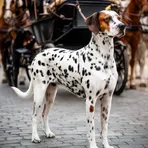
A large dog with short white fur and black or brown spots
Surface Forms
Morphology
A B1 learner who knows 'carriage' and 'dog' can infer that a 'carriage dog' is a dog associated with carriages (e.g., one that runs alongside or accompanies a carriage), so the basic relation is compositional. However, the precise identification as the Dalmatian breed and details like its distinctive spotted coat and historical role are not directly predictable from the parts, making the expression only partially transparent.
Etymology
Carriage dog comes from a simple picture: a carriage is a horse-drawn vehicle and a dog ran beside it. These spotted dogs ran to guard the horses and clear the way, so the name came to mean the large, spotted breed we call a 'Dalmatian'.