
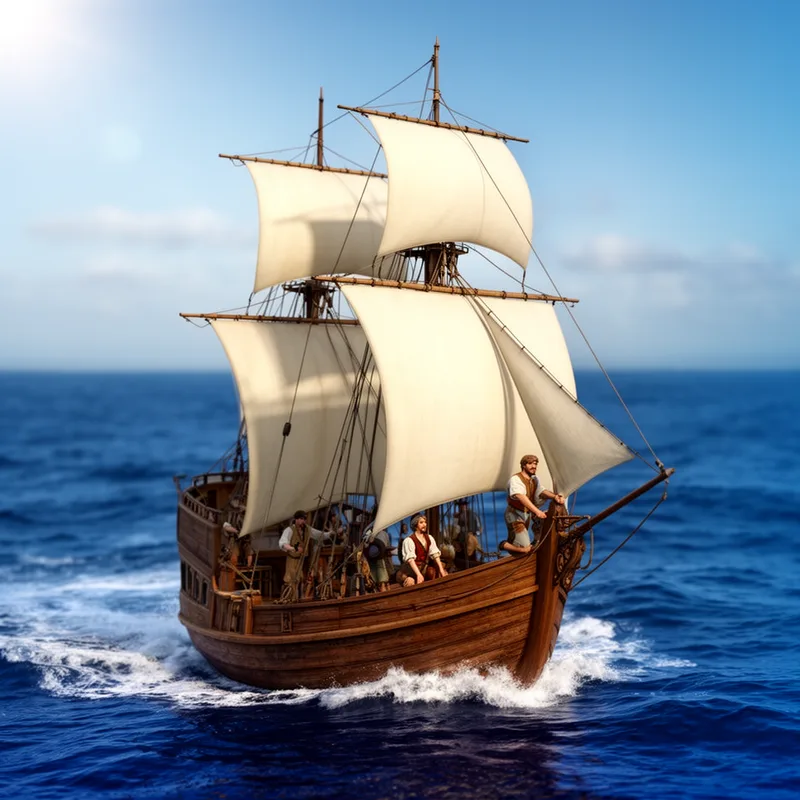
caravel
 1
9.8

- noun
- /ˈkærəˌvɛl/
- Archaic
- Our caravels depart for Spain the day after tomorrow.
- caravels sailed
- Columbus and his caravels
Examples
-
The roof of the jungle, the bay beyond, the caravel at anchor.
Fiction book (1992) -
We see the two caravels, dwarfed by the massive seas.
Fiction book (1992) -
Then, of its own accord, the caravel turned its prow towards land, entered the port, and drew alongside the quay.
Fiction book (1999) -
The caravel Victoria was sailed back to Spain by the Basque captain Juan Sebastian Elcano, amid many hardships.
Blog text (21) -
In the 15th century, explorers relied on the caravel to navigate uncharted waters.
-
To commemorate the Age of Exploration, a fleet of caravels was built for a historical reenactment.
-
The small and nimble caravel allowed sailors to travel quickly along the coastlines.
Surface Forms
Etymology
Caravel comes from the Portuguese caravela, and probably from the Arabic qarib which means 'small boat'. So a caravel is a small, fast sailing ship used by Portuguese and Spanish explorers in the 15th and 16th centuries.