
capsid
 1
8.4

- noun
- /ˈkæpsɪd/
- Specialized
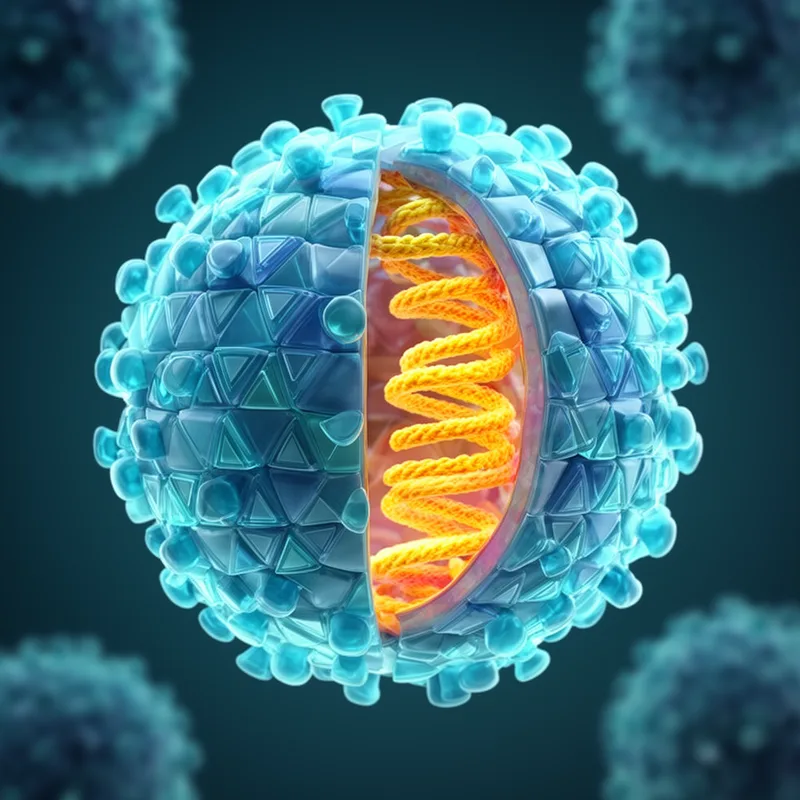
- The capsid is the protective protein shell that surrounds the virus's genetic material.
- capsid protein
- capsid gene
- capsid assembly
Examples
-
Outside its cellular host, the viral genome would disintegrate without the protection of its coat, the capsid.
Academic text (2004) -
The aim was to derive the optimal capsid energy spectrum.
Academic text (2004) -
Such a capsid, being the wrong size, would no longer provide the right, tight fit for the genome.
Academic text (2004) -
To see why, consider a capsid that has just one more capsomer than the number M at a minimum.
Academic text (2004) -
But if the capsid were too strong, the infectious genome would be trapped inside.
Academic text (2004) -
And the genetic material is held in a capsule called the capsid that has the form of an icosahedron.
-
Many common colds are caused by rhinoviruses that have a geometric protein structure called a capsid instead of a lipid membrane.
-
When the UCLA team began investigating capsid assembly four years ago, modeling the kinetics of capsid assembly molecule by molecule was intractable.
Academic text (2004) -
Turnip yellow mosaic virus, as shown on the left, has a roughly spherical capsid comprising 12 pentameric capsomers and 20 hexameric capsomers.
Academic text (2004) -
Researchers are studying the capsid structure to understand how it interacts with host cells.
Surface Forms
Etymology
The word capsid comes from capsule, a word for a small 'box' or 'container', and the ending -id means 'like' or 'related to'. So a capsid is like a tiny 'box' that holds and protects a virus's genetic material.