
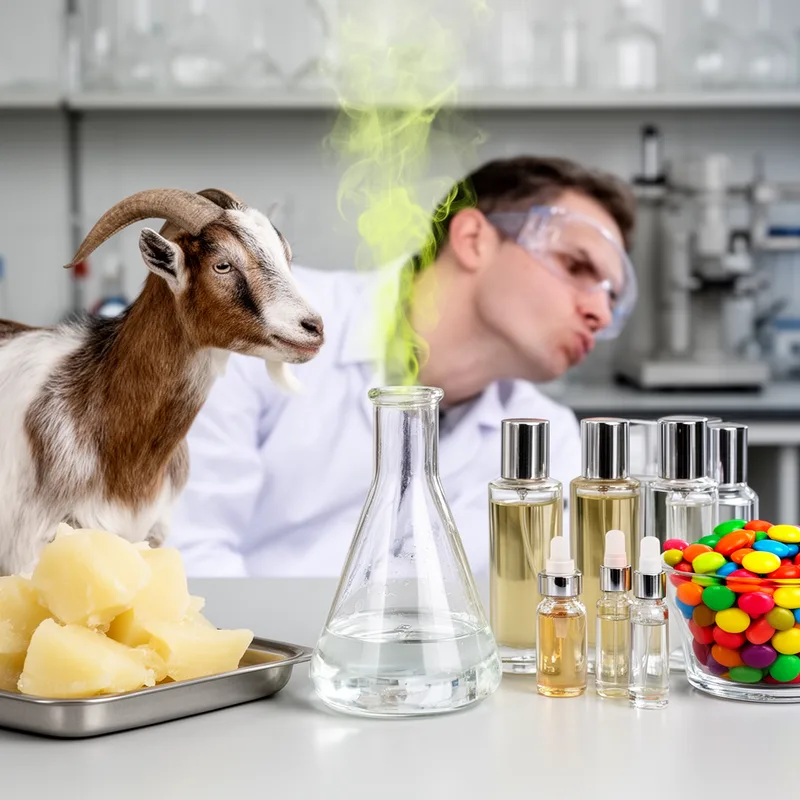
caproic acid
- noun
- /ˈkæproʊɪk ˈæsɪd/
- Specialized
- The strong odor of caproic acid is reminiscent of goats and can be detected in some cheeses.
Examples
-
Caproic acid is often used in the production of artificial flavors and perfumes.
-
Researchers analyzed the presence of caproic acid in various animal fats.
-
The strong smell of caproic acid is often associated with goats.
-
Many flavorings contain caproic acid for its unique taste.
-
Caproic acid is often used in the production of artificial flavors and perfumes.
-
The strong odor of caproic acid is reminiscent of goats and can be detected in some cheeses.
-
Researchers analyzed the presence of caproic acid in various animal fats.
Synonyms

A fatty acid with six carbon atoms that has a strong smell like goat milk
Surface Forms
Morphology
caproic + acid
The modifier 'caproic' is a rare, technical formation (from Latin capra ‘goat’) that is not a decomposable or familiar English word for a B1 learner, and the provided entry even lacks a dictionary definition. Knowing only the common word 'acid' would not allow a learner to infer the specific sense ‘a fatty acid with a goat‑like odor,’ so the expression is not transparently derivable from its parts.
Etymology
Caproic acid may come from an old word capro- meaning 'goat', because the acid often has a strong 'goat-like' smell. So the name is a simple memory hook: think of a strong 'goat-like' smell when you hear caproic acid, which helps explain its use in flavors and some industrial products.

