
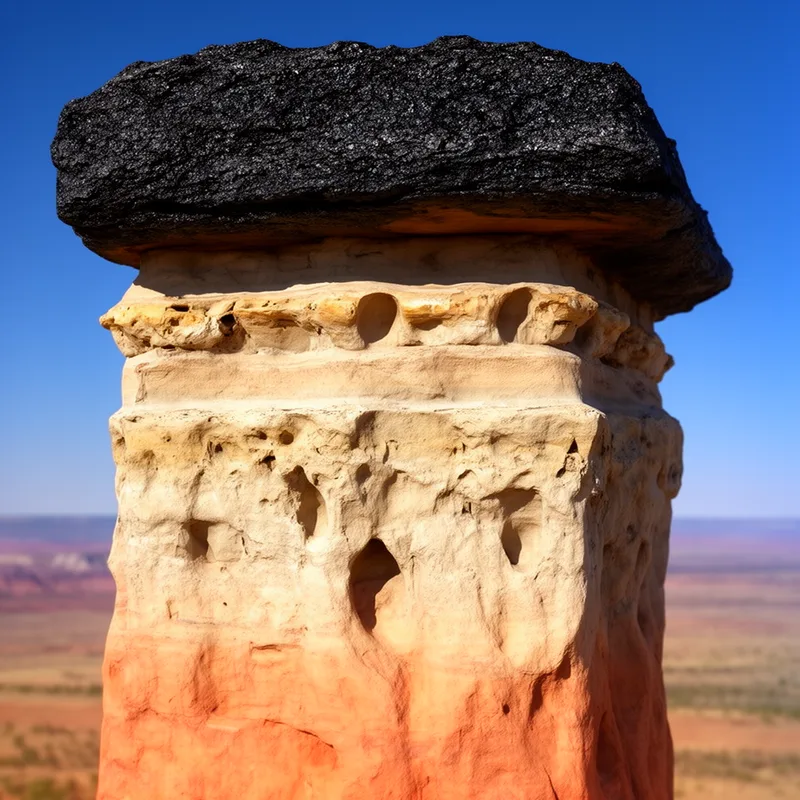
caprock


 1
8.2
- noun
- /ˈkæpˌrɑk/
- Specialized
- Cenotes (sinkholes) and wells punched through the hard limestone caprock provide access to the region's principal water supply: groundwater.
- caprock layer
Examples
-
The caprock formed a protective barrier over the softer layers of rock beneath it.
-
I look at it for several long moments, and then I realize: the profile in the center is The Lighthouse—that is the very curve of the tower's caprock tip against the sky.
Academic text (2007) -
"That particular day, she wasn't describing the canyon that she often came to, but the caprock plains above.
Academic text (2007) -
So the shales that we're talking about are, they are the same shale that we use as caprocks for CCS.
-
"Marsden Hartley would write of her work, in 1921, "She looks as if she had ridden the millions of miles of her every known imaginary horizon, and has left all her horses lying dead in their tracks." V. Ogallala Caprock
Academic text (2007) -
Geologists often study the caprock to understand how it seals underground resources.
-
In the canyon, the caprock creates a distinctive ledge that prevents erosion of the soil below.
Surface Forms
Morphology
Etymology
Caprock comes from the two words cap and rock, where cap means a 'covering' or 'hat' that sits on top of something. So a caprock is a hard 'covering' of rock that sits above softer layers and helps protect them from erosion.