
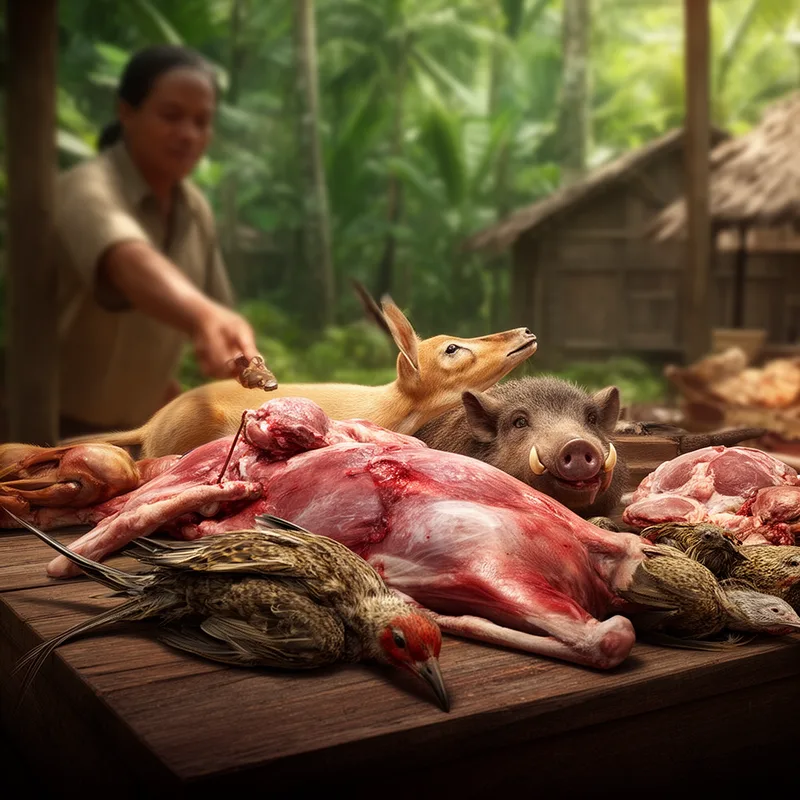
bushmeat
 1
9.0
1
9.0

- noun
- /ˈbʊʃˌmiːt/
- Hunting is also common, and bushmeat is a major source of protein for locals.
- bushmeat market
- primate bushmeat
- nonhuman primate bushmeat
Examples
-
In many rural areas of Africa, families depend on bushmeat as a vital source of protein.
-
Bushmeat is whatever wild animals are captured and killed, and it often includes the remains of nonhuman primates.
Academic text (2004) -
Indeed, for many consumers, bushmeat is already a luxury item.
Academic text (2011) -
Bushmeat is the main source of animal protein in West Africa.
Academic text (2004) -
"Humans throughout the Congo Basin rely primarily on bushmeat for protein, so the implications for leopards are immense," says Henschel.
Academic text (2011) -
For example, in Ghana, it was found that a significant fine applied to the sale of bushmeat in urban markets was sufficient to reduce hunting to sustainable levels (Damania et al. 2005).
Academic text (2011) -
Moreover, in many places, a large proportion of bushmeat is shot by immigrant hunters and consumed in urban restaurants (e.g., Poulsen et al. 2009).
Academic text (2011) -
The growing demand for bushmeat has led to significant declines in wildlife populations.
-
Conservationists are concerned that the hunting of bushmeat threatens both species and ecosystems.
How Wild

Surface Forms
Morphology
Etymology
Bushmeat joins bush ('wild area' or small forest) and meat ('animal food'). It means meat from wild animals people hunt in the bush, especially in parts of Africa and Asia.