
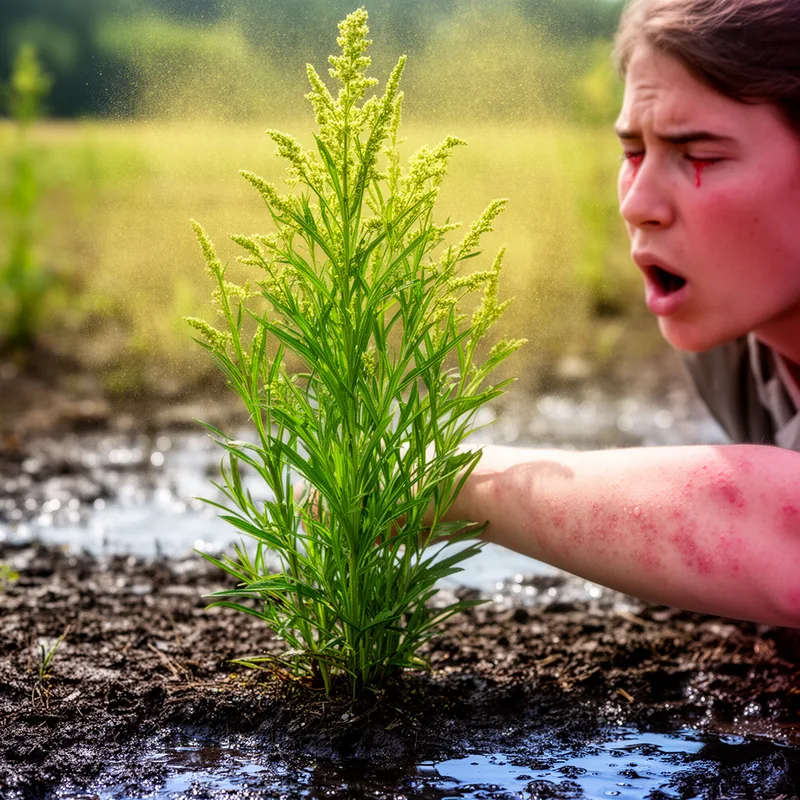
burweed marsh elder
- noun
- /ˈbɜrˌwid mɑrʃ ˈɛldər/
- US
- Brushing against burweed marsh elder can cause skin irritation known as contact dermatitis.
Examples
-
People who are allergic to pollen may react strongly when burweed marsh elder is in bloom.
-
Farmers often struggle to control burweed marsh elder in fields with moist, nutrient-rich soil.
-
The burweed marsh elder thrives in wetland areas.
-
Many people are allergic to burweed marsh elder pollen.
-
Brushing against burweed marsh elder can cause skin irritation known as contact dermatitis.
-
Many people suffer from hay fever when burweed marsh elder releases its abundant pollen.
-
Farmers often find that burweed marsh elder flourishes in fields with moist soil, making it difficult to manage.
Synonyms

A tall annual plant called marsh elder that often causes hay fever and skin rashes

A tall plant that makes a lot of pollen and can cause hay fever or itchy rashes when touched
Surface Forms
Morphology
The noun phrase is compositionally built: 'marsh elder' signals a wetland plant and 'burweed' functions as a modifier, so a learner who knows the parts would infer it is a kind of marsh plant. However, the specific species identity and detailed properties (allergenic pollen, contact dermatitis) are not predictable from the constituents and 'burweed' is an obscure lexical item, so the meaning is only partially transparent.
Etymology
Burweed marsh elder comes from two images: burweed means the plant makes clingy burrs on its seeds, and marsh elder shows it grows in wet, marshy fields and looks a bit like elder plants. Those clingy burrs and the heavy pollen explain why the plant can 'irritate skin' and cause 'hay fever'.

