

bullock block
- noun
- Archaic
- The crew attached the halyard to the bullock block at the top of the mast.
Examples
-
With a creak, the rope ran smoothly through the bullock block as the sailors worked.
-
The old bullock block needed to be replaced before raising the new sails.
-
The sailor adjusted the bullock block carefully.
-
Many ships use bullock blocks for their rigging.
-
The crew attached the halyard to the bullock block at the top of the mast.
-
The old bullock block needed to be replaced before raising the new sails.
-
With a creak, the rope ran smoothly through the bullock block as the sailors worked.
Synonyms

 15
6.8
15
6.8

A wheel with a groove that a rope runs through
 1
9.9
1
9.9
A small wheel on the top part of a ship's mast that helps ropes move

A wheel with a groove that a rope runs in to lift things or change the rope's direction
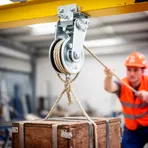
A wheel with a groove for a rope that helps lift or move heavy things
Surface Forms
Morphology
bullock + block
This is a specialized, archaic nautical term where the modifier 'bullock' does not transparently signal the specific type or location of the pulley. Even if a learner knows 'block' (a pulley) and 'bullock' only as 'young bull' (or encounters an unknown form), there is no predictable compositional link to a topmast pulley, so the overall meaning cannot be derived from the parts.
Etymology
Bullock block may come from the idea of a bullock because the wooden block high on a ship had to carry heavy loads like a bull's strength. It was a pulley fixed at the top of the mast to help sailors lift and move ropes, so the name came to mean 'a pulley at the top of a mast used to handle ropes'.