

bull nettle
- noun
- /bʊl ˈnɛtəl/
- US
 :
ortiga de toro
:
ortiga de toro
- You should wear gloves when handling bull nettle because of its sharp spines.
Examples
-
Gardeners in the South often struggle to remove bull nettle from their lawns.
-
The field was dotted with bull nettle, making it difficult to walk barefoot.
-
The bull nettle is known for its painful sting.
-
Many people avoid touching bull nettles in the wild.
-
While hiking in the forest, I accidentally brushed against abull nettle and felt its sharp sting.
-
The children learned to avoidbull nettles during their nature walk because of the irritating thorns.
-
She picked some berries but got stung by abull nettle when she reached too close to the plant.
Synonyms
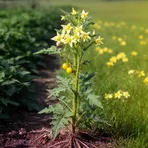
A prickly weed that lives many years with pale yellow flowers and yellow berries, often in fields and gardens

A prickly weed with pale yellow flowers and yellow berry-like fruit found in the southeastern United States

A prickly plant with pale yellow flowers and poisonous yellow berries that can irritate the skin

A rough prickly weed with pale yellow flowers and small yellow berries that can be poisonous
How Prickly


Surface Forms
Morphology
bull + nettle
This is a straightforward compound naming a type of nettle: a B1 learner who knows 'nettle' (a stinging plant) and 'bull' (male cow, suggesting largeness/strength) can infer this refers to a particular, likely coarse or strong, nettle. The animal+plant naming pattern is common cross-linguistically, so the overall meaning is compositional and derivable from the parts.
Etymology
Bull nettle may come from farmers who thought the plant's sharp prickles hurt like a bull's push. The word bull shows its size or strength and nettle means a stinging plant, so the name tells you it is a large, prickly plant that will 'sting' if you touch it.