

buckyball
 1
8.9

- noun
- /ˈbʌkiˌbɔl/
- Specialized
- Until then, we may as well be dreaming about carbon buckyball nanotube "beanstalks" taking us to orbit.
- buckyball molecule
- carbon-bonded buckyballs
- atoms inside buckyballs
Examples
-
Evaporating the benzene left crystals of neatly piled up C60 buckyballs, the third crystalline form of carbon.
Academic text (1996) -
It is a single-walled carbon cylinder just wide enough for a C60 buckyball to slide through.
Academic text (1996) -
The three laureates came to the buckyball business by different routes.
Academic text (1996) -
The other is studying the growth of buckyballs and buckytubes.
Academic text (1996) -
It's significant that abortion opponents never carry posters depicting newly conceived embryos, which, when magnified, look more like buckyballs than people.
Academic text (2007) -
Curl Jr. was awarded the Nobel Prize in Chemistry in 1996 for the discovery of buckyballs and was one of many Nobel Prize winners who credit the kits for inspiring their careers.
Blog text (14) -
Buckytubes are formed in much the same way as buckyballs, except that metal atoms placed in the vapor somehow deter graphene sheets from closing up into balls.
Academic text (1996) -
All the "buckyballs" are basically hexagonally ordered graphitelike carbon sheets distorted into closed polyhedra by intervening pentagons of carbon atoms.
Academic text (1996) -
Scientists have synthesized a new compound made entirely of buckyball molecules, which could revolutionize nanotechnology.
-
Researchers discovered that buckyball structures can stabilize certain chemicals, making them more effective in drug delivery systems.
Synonyms
 1
9.9
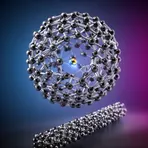
A hollow ball or tube made of many carbon atoms

 1
9.9
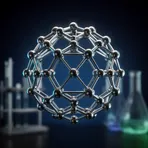
A round molecule made of sixty carbon atoms like a small soccer ball
Surface Forms
Morphology
Etymology
The word buckyball comes from the name Buckminster Fuller and the word ball, because the molecule looks like his dome designs and like a round 'soccer ball'. So a buckyball is an almost spherical molecule made of 60 carbon atoms arranged in a hollow 'cage'.