
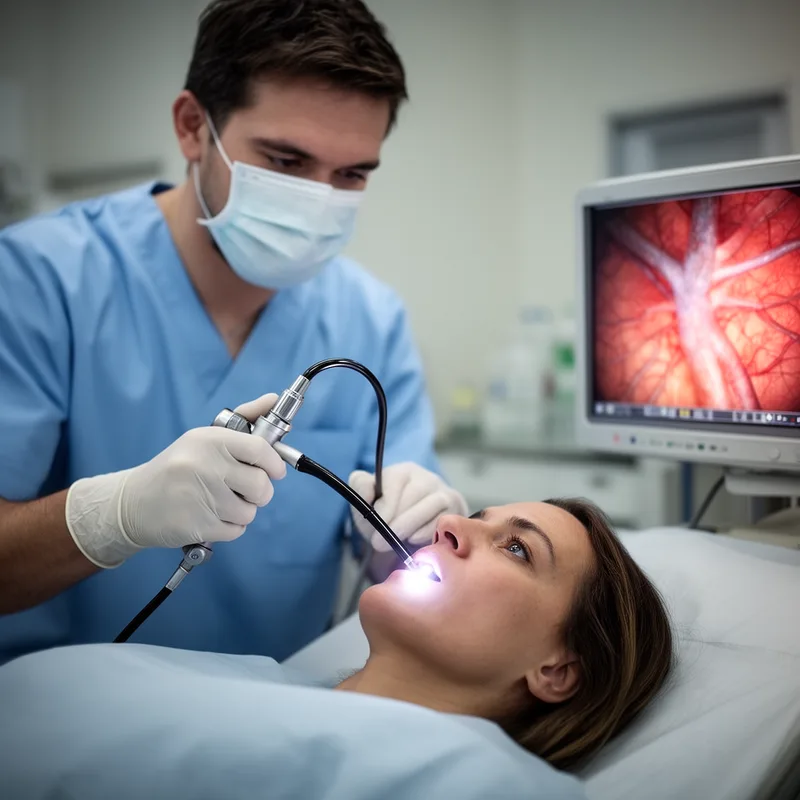
bronchoscope


 1
8.8
1
8.8
- noun
- /ˈbrɒŋkəˌskoʊp/
- Specialized
- During the procedure, the surgeon inserted a bronchoscope to collect tissue samples from the lungs.
Examples
-
Traditionally, when doctors insert a conventional bronchoscope into the patient to examine the lungs, the devices are used in concert with a flat CT image.
Academic text (2004) -
A rigid bronchoscope, which was kept ready by the ENT surgeons, was introduced and the airway dilated with it.
Academic text (2007) -
To guide the bronchoscope, the system features software that generates the patient's original CT images in three dimensions.
Academic text (2004) -
The miniaturized, long bronchoscope includes what Besser calls a localization center on its tip.
Academic text (2004) -
As the bronchoscope reaches one, the physician inserts tools to take samples for biopsy, Besser said.
Academic text (2004) -
In the second case, the glottic opening was so small that it had to be dilated with a rigid bronchoscope to permit tracheal intubation.
Academic text (2007) -
In some patients with marked airway pathology, awake tracheal intubation utilizing a fiberoptic bronchoscope may be recommended (Moos et al., 2005).
Academic text (2006) -
The doctor used a bronchoscope to closely examine the patient's bronchial tubes for any signs of infection.
-
In order to diagnose the issue, the pulmonologist recommended a bronchoscope for a detailed view of the airways.
Surface Forms
Morphology
bronchoscope = broncho + scope
The word is built compositionally from the medical combining form broncho- and -scope 'instrument for viewing', but the specialized medical meaning is not fully obvious to an average learner.
Etymology
The word bronchoscope breaks into broncho- 'windpipe' and -scope 'to look', the same -scope you see in telescope and microscope. So a bronchoscope is a thin tube doctors use to look inside the bronchial tubes or airways.