
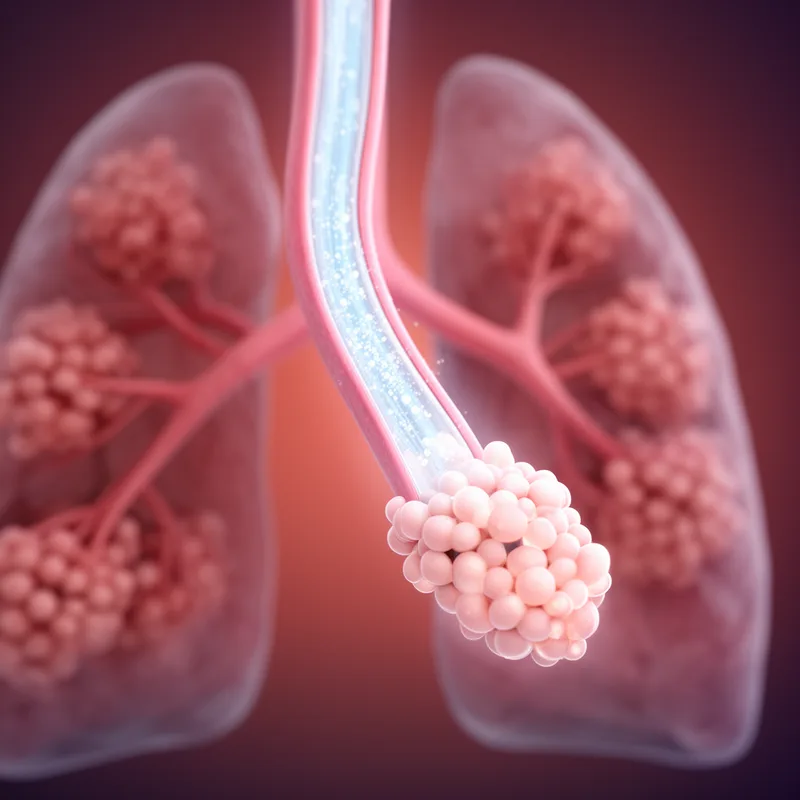
bronchiole
- noun
- /ˈbrɒŋkiˌoʊl/
- Specialized
- Emphysema is a condition of the lung characterized by abnormal permanent enlargement of the air spaces distal to the terminal bronchiole, accompanied by destruction of their walls.
Examples
-
Morphometric dimensions of the obstructed bronchiole are listed, which include volume (mm³), cross-sectional area (mm²), and diameter (mm).
Academic text (2017) -
Airway obstruction: risk factors, especially smoking, can cause irreversible narrowing of the bronchioles.
Academic text (2014) -
Asthma occurs in the lower part, centered on the lungs and bronchiole tubes.
Academic text (2011) -
Particularly, the disease in question is located in the deep lung (G7-9) and is small in size (bronchiole diameter is 3.74 mm).
Academic text (2017) -
The trachea, bronchi, and bronchioles of these animals were explored carefully for the presence of the adult lungworms.
Academic text (2014) -
In asthma sufferers, the bronchioles become narrowed and tight and can produce spasms.
Academic text (2011) -
Postmortem examinations of euthanized ferrets revealed bronchointerstitial pneumonia with prominent hyperplasia of bronchiole-associated lymphoid tissue.
Academic text (2012) -
In a healthy lung, air travels through the trachea and into the bronchioles, where oxygen is exchanged for carbon dioxide.
-
When a person has asthma, inflammation can cause the bronchioles to constrict, leading to difficulty in breathing.
-
Bronchiolitis typically causes swelling in the bronchioles, making it hard for the lungs to function properly.
How Big


Surface Forms
Morphology
Etymology
The word bronchiole comes from bronch- meaning 'windpipe' and the ending -iole meaning 'small', so it literally means a 'little windpipe' and you also see bronch- in bronchitis. That's why a bronchiole is one of the tiny air tubes in the lung that lead to the air sacs.