

broad-leaved
- adjective
- /brɔd-liːvd/
- Many broad-leaved plants thrive in moist environments, making them ideal for a lush garden.
- broad-leaved evergreen
- broad-leaved forests
- broad-leaved tree
Examples
-
Most or all nontropical broad-leaved evergreen forests are poorly represented in compilations of ecological data.
Academic text (1997) -
Within the first year of our study, we identified well over one hundred species of broad-leaved plants that the animal eats; about twenty were particularly favored.
Academic text (1992) -
And, as Box (1995) notes, evergreen broad-leaved forests are not recognized in the analysis of satellite data.
Academic text (1997) -
The river swamp is dominated by bald cypress, with sweet bay magnolia and green ash as the prominent broad-leaved trees.
Academic text (1998) -
Although pine forests have only half the biomass of the surrounding broad-leaved forests, they maintain similar NPP (Singh et al. 1994).
Academic text (1997) -
Common trees are red spruce and balsam fir, interspersed with such broad-leaved species as American beech and sugar maple.
Academic text (1998) -
Himalayan forests are dominated by broad-leaved evergreen taxa, as is much of the rest of mesic Asia (Song 1995, Wolfe 1979).
Academic text (1997) -
A third pattern of leaf development occurs in northwestern North America, where broad-leaved trees are of minor importance (Waring and Franklin 1979) as leaves expand during the moist season, but leaf maturity coincides with the dry season.
Academic text (1997) -
The forest is filled with broad-leaved trees that provide shade during the hot summer months.
-
In the spring, the broad-leaved foliage of the trees bursts forth, adding vibrant greens to the landscape.
Synonyms
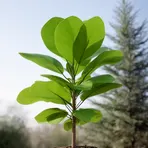
A plant or tree that has wide, flat leaves
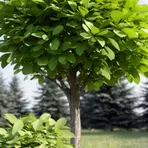
A plant or tree with wide flat leaves rather than needles

A plant with large leaves, like many tropical houseplants
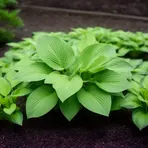
A plant with leaves larger than those of other plants of the same kind
Antonyms


How Broad

Surface Forms
Morphology
Etymology
Broad-leaved is made of two parts: broad meaning 'wide' and -leaved from the word 'leaf'. So broad-leaved literally means 'having wide leaves' and is used for plants with flat, wide leaves rather than thin, needle-like ones.

