
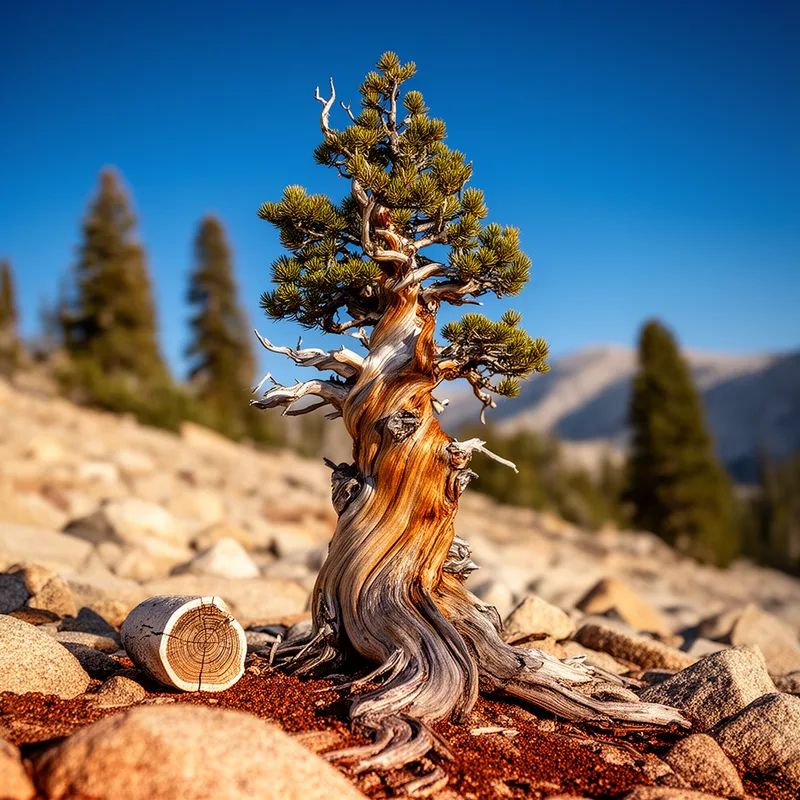
bristlecone pine
 1
8.6
1
8.6

- noun
- /ˈbrɪsəlˌkoʊn paɪn/
- US
- Geneticist Christopher M. Richards, in collaboration with U.S. Forest Service scientist Anna Schoettle, is trying to assess the diversity of bristlecone pines and to identify, for collection, germplasm that represents what is in the wild.
- the oldest bristlecone pine
- an ancient bristlecone pine
- bristlecone pine trees
Examples
-
The outer wood of the Bristlecone pine, when exposed to winter ice driven by high winds, becomes beautifully sculpted and polished.
Blog text (33) -
It's a 55-foot-tall bristlecone pine that's nearly 5,000 years old.
-
And to, to, to think about a tree, an individual bristlecone pine that's older than writing.
-
I experienced the bristlecone pine at White Mountain, Inyo National Forest, CA, 2005.
Blog text (31) -
Bristlecone pines could be considered Earth's oldest living inhabitants, since some of them may be 5,000 years old.
Academic text (2005) -
Some bristlecone pine trees in the Rocky Mountains are still alive after 4,600 years.
-
California boasts the world's tallest trees, the redwoods, and the oldest, bristlecone pines.
Synonyms

A very old pine tree from western United States mountains that can live for thousands of years

A slow-growing pine from the Rocky Mountains that lives a long time and has short needles in groups of five
A small slow-growing pine tree from the Rocky Mountains that can live for thousands of years
How Long-Lived

Surface Forms
Morphology
bristlecone + pine
The head noun 'pine' clearly signals that this is a type of tree, so a learner who knows 'pine' will likely infer it is a kind of pine. However, 'bristlecone' is not a common word and its internal structure (bristle + cone) only partially reveals the specific botanical traits (thorn-tipped cone scales, extreme longevity, slow growth), so the full encyclopedic meaning is not predictable from the constituents alone.
Etymology
Bristlecone pine comes from the tree's small cones with stiff, hair-like points called bristles, and from it being a kind of pine. That's why the name points to the slow-growing, very old pine tree we mean today.