

brash oak
- noun
- /bræʃ oʊk/
- US
- Local farmers often use brash oak wood for durable fence posts due to its moisture resistance.
Examples
-
The leaves of the brash oak are shaped distinctively, making the tree easy to identify in the wild.
-
After the storm, they found several brash oak saplings uprooted near the fence line.
-
The brash oak is often found in wetland areas.
-
Many brash oaks grow near the riverbank.
-
Local farmers often use brash oak wood for durable fence posts due to its moisture resistance.
-
After the storm, they found several brash oak saplings uprooted near the fence line.
-
The leaves of the brash oak are shaped distinctively, making the tree easy to identify in the wild.
Synonyms

A small tree with dark green lobed leaves and wood that resists rot, often used for fence posts
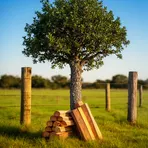
A small tree with strong wood that does not rot easily, used for fence posts

A small oak tree from eastern and central United States with very strong wood used for fence posts
Surface Forms
Morphology
brash + oak
The phrase names a specific species of oak and its detailed botanical properties cannot be predicted from the constituent words. Even if a learner knows 'oak,' the modifier 'brash' is rare/unclear in this lexical context (and does not transparently signal the tree's size, leaves, or wood properties), so the overall meaning is lexicalized and not derivable from the parts.
Etymology
Brash oak may come from the old word brash, meaning the broken branches and twigs left after cutting trees. Young oak trees that grew in that rough pile were small but very tough, and farmers used their wood for 'fence posts', so the name came to mean a small, durable oak.

