
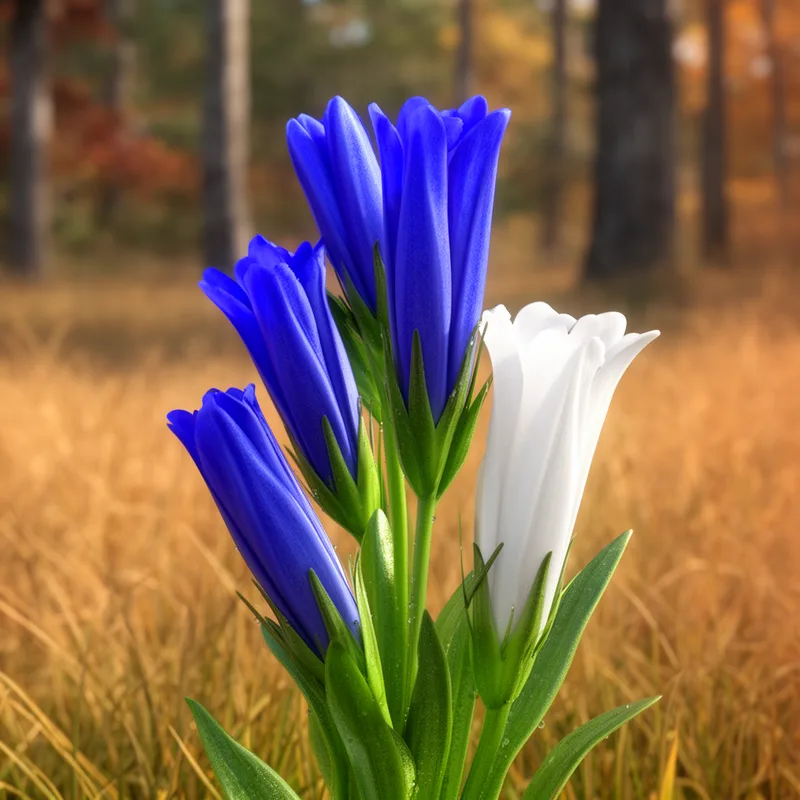
bottle gentian
- noun
- /ˈbɑtəl ˈdʒɛnʃən/
- US
- Unlike most other wildflowers, bottle gentian blooms rarely open fully.
Examples
-
The vibrant blue flowers of the bottle gentian brighten many autumn meadows.
-
We identified several bottle gentians growing along the edge of the woodland trail.
-
The bottle gentian blooms in late summer.
-
Have you seen the bottle gentians in the garden?
-
The vibrant blue flowers of the bottle gentian brighten many autumn meadows.
-
We identified several bottle gentians growing along the edge of the woodland trail.
-
Unlike most other wildflowers, bottle gentian blooms rarely open fully.
Synonyms
A plant from eastern North America with blue or white tube-shaped flowers that stay mostly closed

A North American wildflower with tube-shaped blue, white, or purple flowers that stay mostly closed
A plant with blue or purple flowers shaped like a tube that stay mostly closed
Surface Forms
Morphology
bottle + gentian
The compound is transparently built from 'bottle' (indicating a bottle-like shape) + 'gentian' (a type of flowering plant), so its meaning — a gentian with tubular, mostly closed, bottle-shaped flowers — can be inferred from the parts. Noun–noun subtype naming is a common, cross-linguistic pattern, making this predictable for a B1 learner who knows both constituents.
Etymology
The plant name bottle gentian comes from the flower's shape: each flower looks like a small bottle, with petals forming a tight tube that stay 'mostly closed'. That's why the name refers to a gentian whose blue or white flowers do not open fully.

