
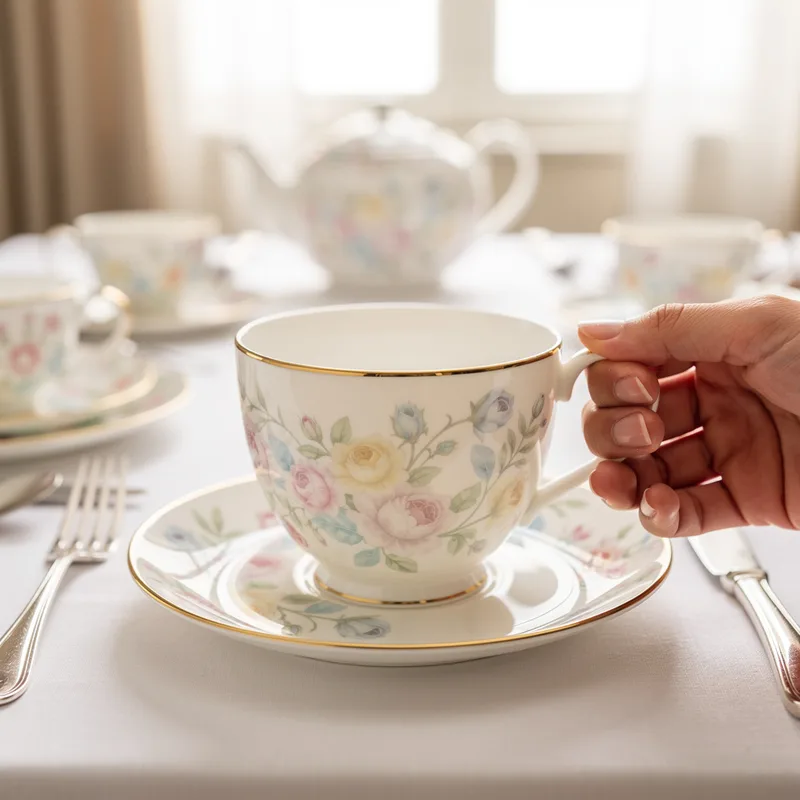
bone china
 2
4.4
2
4.4

- noun
- /boʊn ˈʧaɪnə/
- The tray, heavy with bone china, trembled between her thin wrists.
- fine bone china
- bone china cup
- bone china plate
Loading YouTube…
Watch on YouTubeIt's just John Lewis white bone China hand wash only not for the microwave.
- It's just John Lewis white bone China hand wash only not for the microwave.
Examples
-
When Mama and I drove up one Saturday, Caroline served us shrimp salad on bone china with a scalloped gold edge.
Fiction book (1997) -
The elegant bone china plates were displayed beautifully on the dining table.
-
You bring the bone china cup to your lips.
Fiction book (1997) -
It's just John Lewis white bone China hand wash only not for the microwave.
-
The pottery dishes were a copy of a famous French bone china.
Academic text (1998) -
I remove the cozy from the teapot and pour Assam tea, a minute bronze lake, into bone china cups.
Fiction book (1995) -
His dining-room hutch held sterling silver, bone china, real stoneware, and expensive linen napkins.
Fiction book (1995) -
Stainless steel plates, worn griddles, bone china sugar pots—all these relics of childhood have been replaced.
Fiction book (1995) -
She carefully selected a bone china teapot for her afternoon tea party.
-
The restaurant served its finest dishes on bone china, emphasizing the quality of the meal.
Synonyms


How Fine

Surface Forms
Morphology
The compound literally combines 'bone' and 'china', so a learner who knows both words can infer that it is a type of porcelain involving bone, making the core meaning partially predictable. However, the specific manufacturing detail (bone ash) and the technical qualities (fine, translucent, stronger) are specialized and not fully derivable from the constituents, so it is not fully transparent.
Etymology
The noun bone china comes from the real bone used to make it: potters burned animal bones to make a white ash and mixed this with clay to make very thin but strong cups. So the name explains why it is known as a 'fine' and 'strong' kind of china.