

boggy
 2
5.6
2
5.6

- adjective
- /ˈbɔɡi/
- The fields were too boggy to walk across after the heavy rain.
- boggy ground
- boggy area
- boggy patch
Loading YouTube…
Watch on YouTubeAnd amazingly, he stubbed his toe on it and pulled up through this Peaky, boggy soil.
- And amazingly, he stubbed his toe on it and pulled up through this Peaky, boggy soil.
- And without this lower peat layer, the boggy conditions where the water table was quite high and the top surface was quite saturated, all of that is lost.
Examples
-
Alfred fled W deep into the marshlands of the Somerset Levels, at the time a vast area of undrained boggy wetlands.
-
"Boggy ground," Kelsey thought, and cursed Channing for leading her onto it.
Fiction book (1995) -
The water of the bay was still; the boggy beach was dark in the shadows.
Fiction book (1991) -
Today, many of those lakes have filled in with boggy vegetation.
Academic text (2011) -
Bruce Lake has begun to fill with boggy vegetation.
Academic text (2011) -
The Garden of Eden was a boggy swamp just south of Croydon.
-
None of these three woody species grows taller than four inches under these boggy conditions.
Academic text (1995) -
Alakai Swamp is thirty square miles of boggy terrain nestled in a depression of Mount Waialeale.
Academic text (1995) -
Above Ullapool, steep ridges burst like fins out of boggy, treeless hillsides.
Fiction book (1991) -
Habitats in that region include sandy beaches along both the Atlantic Ocean and the Gulf of Mexico and, farther inland, forests of longleaf pine and boggy tracts rich in carnivorous plants.
Academic text (2010)
Synonyms
 73
1.1
73
1.1
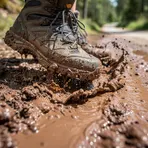
Covered in mud and hard to walk on
 17
1.9
17
1.9
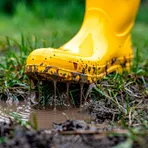
Very wet, soft ground that is often muddy after rain
 8
2.9
8
2.9
Soft, wet ground that is difficult to walk on
 7
3.2
7
3.2
Dirty and covered in mud
 5
1.8
5
1.8
Soft wet land that often has shallow water
 4
1.6
4
1.6
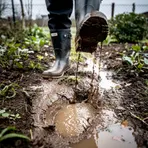
Soft, wet ground that is hard to walk on
 3
5.2
3
5.2
Ground that is full of water and too soft to walk on or grow plants
 1
3.6
1
3.6
Soft and easy to crush, often wet or spongy
 1
4.8
1
4.8
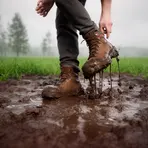
Thick, soft, and wet like mud that makes walking hard
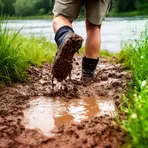
Very muddy, soft ground that is hard to walk on
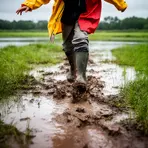
Soft wet ground that makes walking difficult
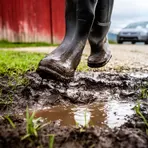
Soft, wet ground that feels like deep mud
Antonyms


How Wet

Surface Forms
Morphology
Etymology
The word boggy comes from the simple word bog, which comes from an Irish word bogach meaning 'soft ground' or 'bog', and the ending -y means 'full of' or 'like'. So, boggy describes ground that is 'soft' and wet, like a bog, and often hard to walk on.