
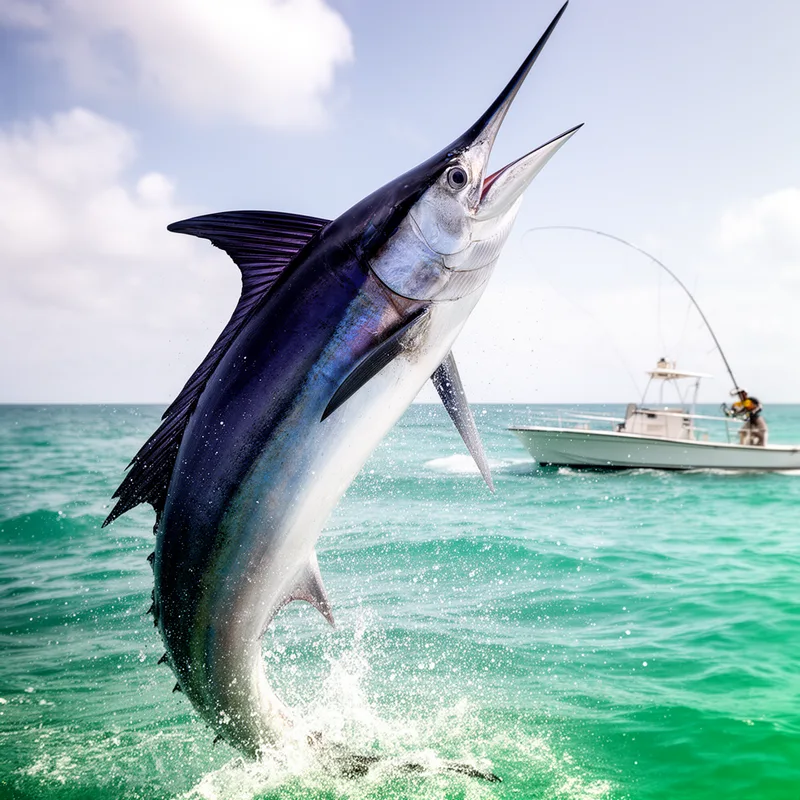
blue marlin


 1
6.1
1
6.1
- noun
- /bluː ˈmɑːrlɪn/
- However, the seasonal movements of blue marlin have not been well documented due to their exceptionally rare event status.
- tagged blue marlin
Examples
-
Blue marlin was the most commonly targeted billfish species (74%), followed by white marlin (49%) and sailfish (43%).
Academic text (1992) -
Before yesterday, with 15 taken, we beat the world record for the number of blue marlin caught in one day.
Blog text (6) -
These data are too few to determine blue marlin migration patterns accurately.
Academic text (1990) -
From 1954 through 1988, 8,447 blue marlin have been tagged.
Academic text (1990) -
Of this group, istiophorids were targeted by 73%, with blue marlin the most sought single species (29%).
Academic text (1992) -
There have been relatively few blue marlin tagged and recaptured off the U.S. East Coast and Bahamas (Fig. 3, 4; Tables 2, 3).
Academic text (1990) -
I caught a magnificent blue marlin while fishing off the coast of Hawaii.
-
The blue marlin is a popular target for sport fishermen due to its size and strength.
-
During our trip, we spotted a blue marlin jumping out of the water, showcasing its vibrant color.
Synonyms
A very large fish with a long pointed bill that lives in warm seas
Surface Forms
Morphology
The meaning ('a marlin that is blue') is directly and compositionally derived from the adjective 'blue' modifying the noun 'marlin', following a common adjective + noun pattern. This transparent color‑labeling of an animal is cross‑linguistically frequent, so a B1 learner who knows both words will understand the basic referent even if they lack specific biological details.
Etymology
Blue marlin may come from sailors who thought the fish's long, pointed jaw looked like a small tool called a 'marlinspike'. The word marlin comes from that tool and blue describes the fish's color, so the name means the large blue fish with a long bill.