

blue bull
- noun
- /blu bʌl/
- Indian
- The blue bull is commonly found in the grasslands of northern India.
Examples
-
Male blue bulls have striking blue-grey coats that help them blend into their surroundings.
-
What a magnificent blue bull!
-
We spotted a herd of blue bull grazing near the edge of the forest.
-
Look at that blue bull!
-
While on a safari, we spotted a majestic blue bull grazing peacefully in the sun.
-
The blue bull is known for its unique blue-grey coat, which helps it blend into its natural habitat.
-
During our visit to the wildlife sanctuary, we observed several blue bulls roaming together near the waterhole.
Synonyms

 1
9.9
1
9.9

A large antelope from India with blue-grey males and brown hornless females
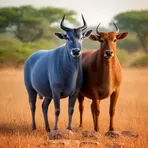
A large antelope from India with blue-grey males and brown females
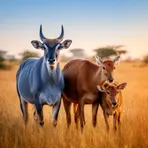
A large antelope from India whose males are blue-grey with horns and females are brown without horns
Surface Forms
Morphology
The phrase is a straightforward color + animal compound: a B1 learner who knows 'blue' and 'bull' will infer a bull-like (male) animal with a blue or blue-grey colour. Although 'blue bull' is a species name (nilgai) and taxonomically an antelope rather than a true cattle bull, the naming is compositional and matches common cross-linguistic color+animal patterns, so its basic meaning is transparent.
Etymology
Blue bull comes from the animal's blue-grey coat and from the Hindi word 'nilgai', which means 'blue cow'. Because the male is large and has horns like a bull, English speakers put blue and bull together, so today blue bull is the common name for this animal.