
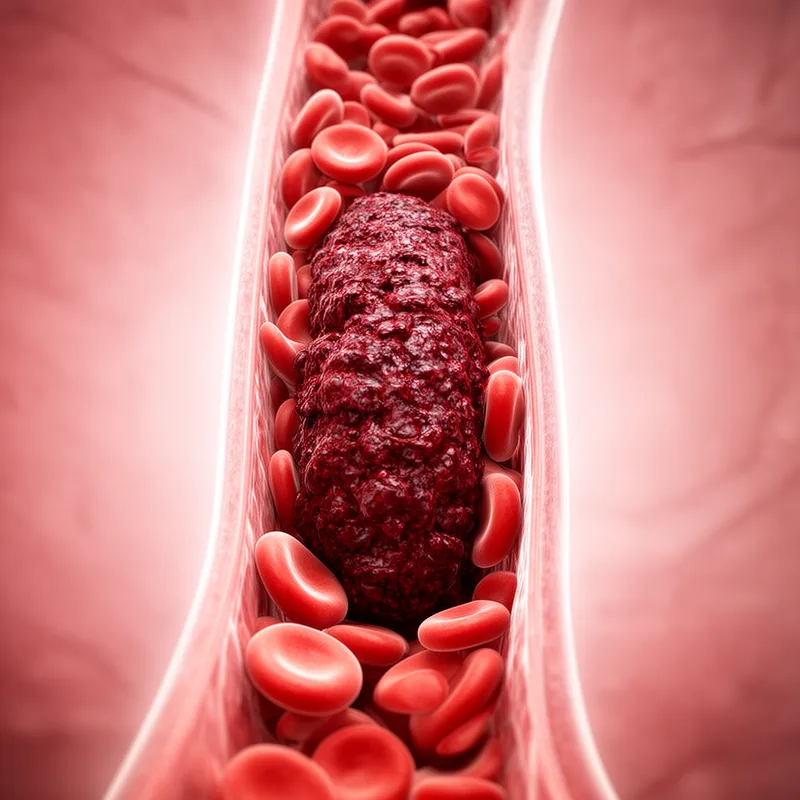
blood clot
 33
3.8
33
3.8

- noun
- /blʌd klɑt/
- Specialized
- He was warned that a blood clot in his leg could move to his heart, leading to a pulmonary embolism.
- develop blood clots
- formation of blood clots
Loading YouTube…
Watch on YouTubeAny of these can be a sign of a blood clot in your lungs.
- Any of these can be a sign of a blood clot in your lungs.
- And there are many risk factors for this type of blood clot related stroke which are modifiable.
- And they abbreviated their endpoint from heart attack strokes and blood clots to just heart attacks.
- What they don't tell you is you're so much more prone to blood clots, especially if you smoke or probably vape.
- I had tight stockings on to protect from blood clots.
- And this we've had a look at and we can't see anything worrying about blood clots in there.
- But hey, I had a pulmonary embolism, which means a piece of blood clot broke off and went to my lungs.
- We'd do that straight away without waiting for a scan to confirm that there's a blood clot there.
- Because again, just like smoking cigarettes is a high risk for blood clots, birth control high risk for blood clots, so is weight gain.
- So it all has to come out while your uterus is contracting back and there can even be little blood clots, which is completely normal but so scary to see.
- It appears to be the higher your platelets and the higher your SHBG, the higher risk of a blood clot.
- Four days later he got got up, a blood clot hit his heart and and he died and my little girl found him.
- And then the, the blood clot was from the skull fracture.
- We're seeing loads of people with unnatural blood clots like white calamari inside them.
Examples
-
The autopsy report indicated that Mystie died of a massive blood clot in her lung.
Academic text (2004) -
The doctor explained that a blood clot can form in the veins and cause serious health issues.
-
And we absolutely need to avoid getting blood clots in our brain.
-
We use it to treat blood clots.
-
This is a blood clot.
-
Any of these can be a sign of a blood clot in your lungs.
-
After his first chemo treatment, he developed a blood clot that could have killed him.
Blog text (18) -
Your husband suffered multiple skull fractures, and we had to remove blood clots from around the brain.
-
As I said, what you will most likely die from is thrombosis, a blood clot lodging in your brain or heart.
Fiction book (1996) -
But hey, I had a pulmonary embolism, which means a piece of blood clot broke off and went to my lungs.
Synonyms
 98
5.0
98
5.0
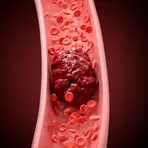
A thick lump of blood that forms inside a blood vessel
 1
8.8
1
8.8
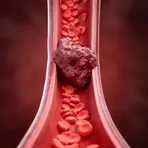
A blood clot that forms inside a vessel and stays attached to the wall
A thick lump that forms when a liquid, like blood, becomes more solid

A thick, sticky lump often made of blood
Surface Forms
Morphology
The meaning is directly compositional: a 'clot' (a lump formed when a liquid coagulates) made of 'blood' is exactly what the compound denotes. Noun–noun compounding of this type is cross-linguistically common and follows an obvious semantic logic, so a B1 learner who knows both words will readily infer the intended medical sense.
Etymology
Blood clot comes from the simple image of blood that has thickened and stuck together into a clot, a hard lump. Because this lump can 'block' a blood vessel and 'stop' blood flow, the phrase means a thick mass in the blood that can be dangerous.