

blood cell
 52
2.5
52
2.5

- noun
- /blʌd sɛl/
- Specialized
 :
célula sanguínea
:
célula sanguínea
- Red blood cells are essential for transporting oxygen throughout the body.
- red blood cells
- white blood cells
- blood cell count
So if you think about cellular turnover, blood cells renew every few weeks.
- So if you think about cellular turnover, blood cells renew every few weeks.
- And the reason that endothelial slippery layer is so important is because blood cells slide right along it.
- And when there are more red blood cells, your blood becomes thicker.
- Well, there are other genetic traits of blood cells including mutations that a lot of sprinters and great bicyclists have that allow your blood cells to carry more oxygen.
- It increases white blood cell counts and certain immune system cells.
- This is very, very important for your blood, your red blood cells to function properly.
- So in your case, your white blood cell count is in the normal range, which is great.
- He says, look, my body has to produce red blood cells or I'll die.
- A neutrophil is a white blood cell whose only job is to fight infection.
- Inflammation, blood type, blood cell composition.
- They throw out now low levels of the blood cells.
Examples
-
My research suggests that the sulfurous compounds of the common onion can increase your red blood cells.
-
But your blood also has white blood cells, and white blood cells are a lot bigger than red blood cells.
-
And they also help with red blood cell production as well.
-
So in your case, your white blood cell count is in the normal range, which is great.
-
There are two common types of blood cells.
-
The patient's white blood cell count and body temperature remained normal.
Academic text (2008) -
So my body produces red blood cells, and if it stops producing red blood cells, I would die.
-
You develop a higher red blood cell count that transports the oxygen.
-
Lymphocytes make up approximately 25% of the total white blood cell count, although this can vary.
Academic text (2012) -
So a red blood cell carries oxygen in a non-smoking adult.
Synonyms
 1
8.3
1
8.3
A cell in the blood such as a red or white blood cell
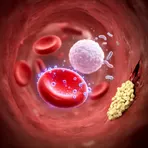
A small cell in blood that carries oxygen, fights infection, or helps stop bleeding
Surface Forms
Morphology
The meaning 'a cell present in blood' is directly derivable from combining 'blood' (the bodily fluid) and 'cell' (a microscopic living unit); this noun-noun composition names a subtype of cell and follows a regular, compositional pattern. The same logic appears across many languages (e.g., Spanish célula sanguínea, French cellule sanguine), so a B1 learner who knows both constituents can reliably infer the meaning.
Etymology
Blood cell is a simple, literal name: a cell, a very small living part, that lives in the blood and often carries oxygen or helps fight germs. So it means 'a small living part found in the blood', like red cells that carry oxygen or white cells that fight infection.