

blackjack oak
- noun
- /ˈblækˌdʒæk oʊk/
- Specialized
- A scattering of blackjack oak, common persimmon, eastern red cedar, southern red oak, southern wax myrtle, and Virginia pine may be seen along a dune.
- southern blackjack oak
Examples
-
In the forest, I often find blackjack oak trees with their distinctively dark bark.
-
A blackjack oak and Small's ragwort at the periphery of May Prairie.
Academic text (1997) -
Upland forest trees forming the upper canopy are loblolly pine, blackjack oak, southern red oak, and red maple.
Academic text (1998) -
It is a mixture of blackjack oak, willow oak, southern red oak, black gum, persimmon, winged elm, red mulberry, and other trees.
Academic text (1997) -
The park is home to various species, including the blackjack oak that provides great shade.
-
While hiking, we spotted a group of blackjack oaks forming a dense thicket near the trail.
Synonyms

 1
8.7
1
8.7

A small tree with dark bark and club-shaped three-lobed leaves that form dense thickets
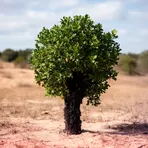
A small bushy oak tree from central and southeastern United States with dark bark and three-lobed leaves
Surface Forms
Morphology
The compound is directly compositional: 'blackjack' (a scrubby oak) combined with 'oak' denotes a specific kind of oak tree, so the overall meaning is predictable from the constituent senses. This is a straightforward taxonomic/compound-noun pattern common across languages, so a B1 learner who knows both constituent meanings would infer the MWE's meaning.
Etymology
Blackjack oak may get its name from the tree's dark bark, the black part, and its small, hard acorns once called 'jacks', the jack part. That's why the name describes a dark, small oak that often grows in big groups and gives good cover for animals.