
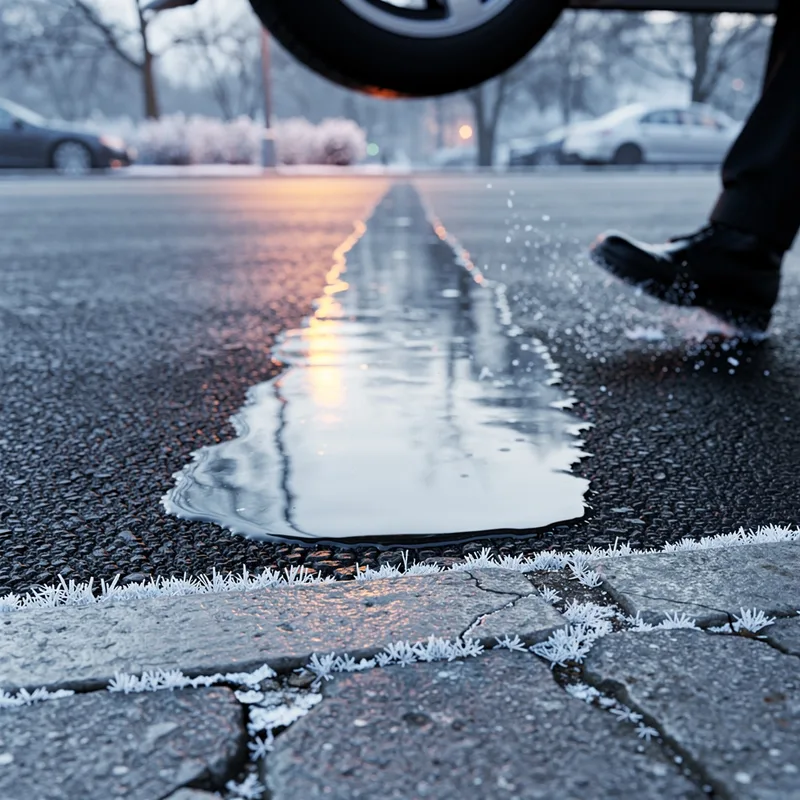
black ice
 4
5.7
4
5.7

- noun
- /blæk aɪs/
- UK
- I looked down into the black ice—the first ice of winter—veined like marble, clear like glass.
- a patch of black ice
- black ice on the road
- skid on black ice
Examples
-
So when we were driving, we hit black ice and the whole thing spun around while I was driving.
-
Be careful when walking outside; there's black ice on the sidewalks.
-
It's black ice out here.
-
In the distance, with the sun gone, the lake looked like an oval of slick black ice.
Fiction book (1991) -
The streets were bare, except for a slick of black ice.
Fiction book (1993) -
We skidded a little on the black ice, but then he got control.
Fiction book (1997) -
By far, the most dangerous road condition in winter is "black ice," which is hard to see because it's transparent and has no snow sticking to it.
Blog text (24) -
Black ice cloaks the road to Grand Portage, five miles from the Canadian border.
Academic text (2009) -
Immediately, the cold slipped under my bare heels, gripped them, and sealed them over, like water freezing to black ice.
Fiction book (2001) -
Usually, the sudden difference occurs in dips or ground hollows—many times I have been bundling along a road and suddenly found black ice just because of topographical changes.
Blog text (10)
How Slippery
- UK
4
5.7
 54
1.0
54
1.0
Surface Forms
Morphology
The combination of 'black' + 'ice' clearly signals a type of ice, so a B1 learner who knows the words will infer it refers to ice with a dark appearance; however, the specialized sense — a thin, nearly invisible and particularly hazardous layer on roads — is not fully predictable from the literal color adjective alone. Because part of the meaning (type of ice) is transparent but the safety/invisibility nuance is a lexicalized, specialized sense that learners must have seen before, the item is best classified as semi-transparent.
Etymology
Black ice gets its name from a very thin, clear layer of ice on the road that lets the dark surface show through, so the road looks 'black' instead of white. So, because it is almost invisible, the phrase means a dangerous patch of ice that drivers and walkers may not see.