

bitter dock
- noun
- /ˈbɪtər dɑk/
- UK
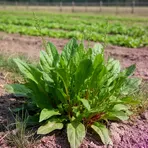
- You can identify bitter dock by its broad, wavy-edged leaves and tall seed stalks.
Examples
-
The field was overgrown with bitter dock, making it difficult to plant new crops.
-
Gardeners often remove bitter dock because its roots can be tough and invasive.
-
The bitter dock grows abundantly in many gardens.
-
Have you ever tried cooking with bitter dock leaves?
-
Gardeners often remove bitter dock because its roots can be tough and invasive.
-
You can identify bitter dock by its broad, wavy-edged leaves and tall seed stalks.
-
The field was overgrown with bitter dock, making it difficult to plant new crops.
Synonyms

 1
8.6
1
8.6

A coarse wild plant with long roots whose young leaves can be eaten

A common weed with large rounded leaves that comes from Europe

A common weed with large blunt leaves and a bitter root

A plant that lives for many years with broad rounded leaves, a bitter root, often growing as a weed
A group of leafy plants like docks or sorrels that often grow wild
Surface Forms
Morphology
The meaning—a dock plant that is bitter—is directly and compositionally derived from 'bitter' (having an acrid taste) modifying 'dock' (the Rumex plant), so a learner who knows both words can infer it denotes a bitter-tasting dock plant. This is a regular adjectival+noun combination following normal English composition (even though 'dock' has other senses like a harbor), making the phrase immediately understandable to B1 learners.
Etymology
Bitter dock is named from the plant's strong taste and the simple word dock for this kind of weed; the leaves and root are very bitter, so people called it a 'bitter' dock. That's why the name points to a bitter-tasting plant.