
betaine


 1
9.9
- noun
- /ˈbeɪteɪn/
- Specialized
- In man, betaine is excreted in urine from the neonatal period until about the age of 2 years, but is not excreted by adults, in whom dimethylamine is produced instead.
- glycine betaine
- betaine and proline
Loading YouTube…
Watch on YouTubeAnd then there's a recovery supplement which has creatine, it has ashwagandha, it has betaine, you know, so the some of the stuff I'm talking about.
- And then there's a recovery supplement which has creatine, it has ashwagandha, it has betaine, you know, so the some of the stuff I'm talking about.
Examples
-
After these baseline studies, betaine treatment (3 g three times daily) was started.
Academic text (1991) -
Rawles is investigating ways to increase the combination's palatability by adding fish solubles, betaine, or other ingredients.
Academic text (2004) -
The compounds are choline and betaine.
Academic text (1999) -
The estimation of glycine betaine serves as a physiological marker for salt stress.
Academic text (2013) -
And then there's a recovery supplement which has creatine, it has ashwagandha, it has betaine, you know, so the some of the stuff I'm talking about.
-
Betaine bypasses the metabolic block by providing an alternative source of methyl groups for the remethylation of homocysteine.
Academic text (1991) -
A lot of research and articles showed a positive relationship between the accretion of proline and glycine betaine and stress tolerance (Hamdia and Shaddad, 2010; Ashraf and Fooland, 2006).
Academic text (2013) -
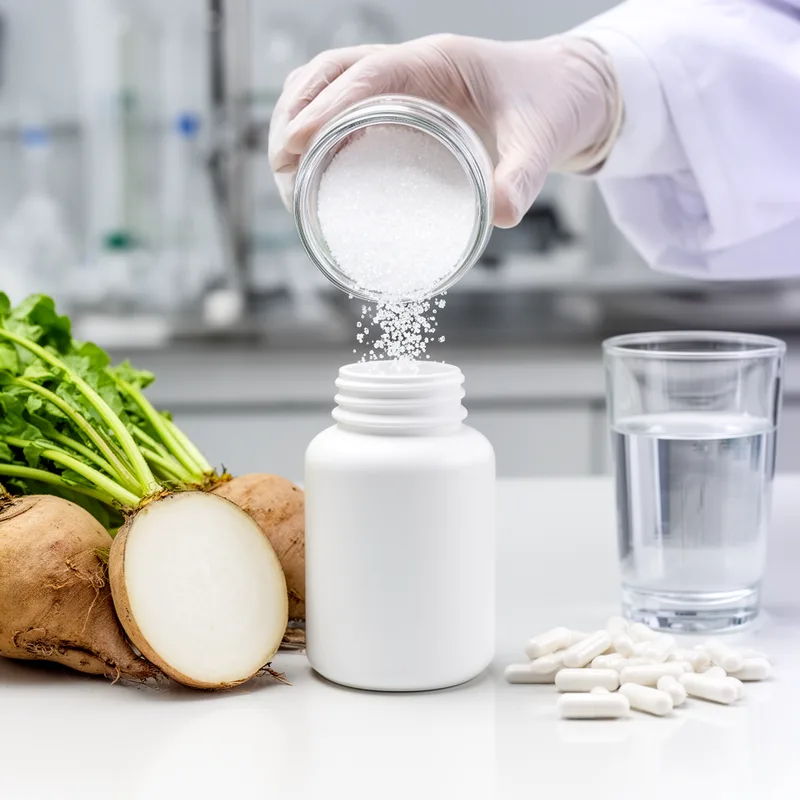
Betaine, found in sugar beets, is often used as a betaine supplement due to its sweet taste.
-
Many athletes add betaine to their diets for its potential benefits in improving exercise performance.
-
Research has indicated that betaine may enhance energy metabolism and support overall health.
Surface Forms
Morphology
Etymology
Betaine gets its name from the sugar beet: the plant name Beta ('beet') plus the chemical ending -ine. So, it is a natural compound first found in beets, which helps explain why it is used in food and nutrition.