
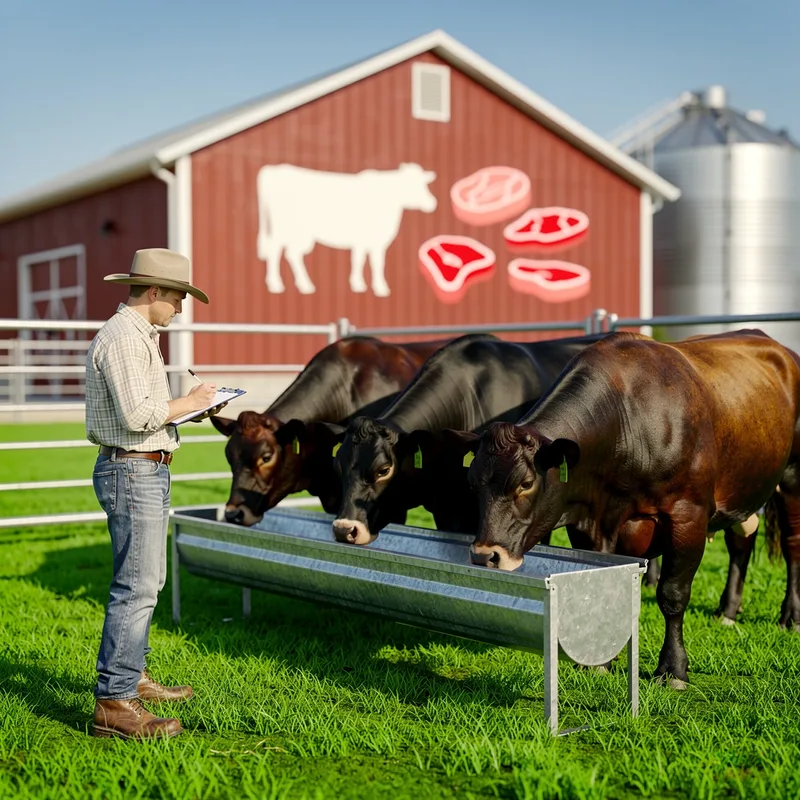
beef cattle
 3
2.6
3
2.6

- noun
- /biːf ˈkætəl/
- Craig and Sophie raise beef cattle on their farm, focusing on sustainable meat production.
- beef cattle production
- beef cattle feedlots
- beef cattle on the farm
Loading YouTube…
Watch on YouTubeAdditionally, we farmed animals as far as beef cattle, chicken and pork.
- Additionally, we farmed animals as far as beef cattle, chicken and pork.
Examples
-
The rest are about evenly split between dairy and beef cattle on feedlots.
Academic text (1995) -
In Nebraska, the fly problem costs beef cattle producers about $5 million annually in lost beef production and chemical control costs.
Academic text (1994) -
Whereas in the case of beef cattle especially, it's many, many hundreds.
-
There have been genetic studies on beef cattle.
-
The resistance is now being seen in Brazilian beef cattle, although it has not been found in the United States yet.
Academic text (2001) -
You know, most beef cattle are are fed growth stimulants.
-
Other than Murphy, the only animals on their farm were beef cattle, sheep, and a few barn cats.
Blog text (4) -
The Piedmont's economy includes the manufacturing of small-scale furniture, electronics, and textiles, as well as tobacco, beef cattle, and poultry production.
Academic text (2003) -
On both sides of the U.S.-Mexico border, beef cattle graze this rangeland mix of grasses and desert shrubs throughout the year.
Academic text (2002) -
Beef cattle and burley tobacco farms prosper on the fertile, limestone-derived soils.
Academic text (2004)
Synonyms
 45
1.0
45
1.0
Animals like cows that farmers raise for meat
Surface Forms
Morphology
The meaning 'cattle raised for meat' is directly and compositionally derived from 'beef' (meat/cattle kept for meat) modifying 'cattle' (livestock). This attributive noun pattern is productive and cross-linguistically common, so a B1 learner who knows both constituents will readily infer the MWE's meaning.
Etymology
Beef cattle is a name made by joining beef (the meat on your plate) and cattle (the live animals on the farm). It means animals raised for 'meat' rather than for 'milk' or 'work', so today it refers to cows kept to produce beef.