
bearberry willow
- noun
- /ˈbɛrˌbɛri ˈwɪloʊ/
- Specialized
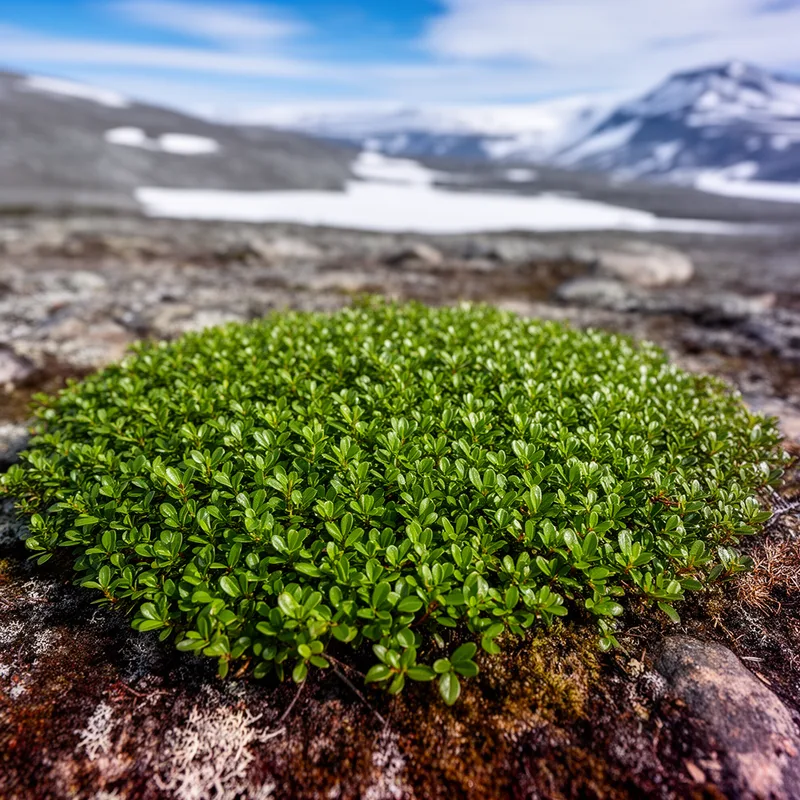
- The bearberry willow thrives in harsh Arctic environments, forming dense mats close to the ground.
Examples
-
I spotted a patch of bearberry willow while hiking through the alpine meadow.
-
Researchers studied the adaptation mechanisms of bearberry willow leaves in Greenland's tundra.
-
The bearberry willow thrives in cold climates.
-
Many bearberry willows grow along the tundra.
-
I spotted a patch of bearberry willow while hiking through the alpine meadow.
-
Researchers studied the adaptation mechanisms of bearberry willow leaves in Greenland's tundra.
-
The bearberry willow thrives in harsh Arctic environments, forming dense mats close to the ground.
Synonyms

A low shrub that forms a flat mat with small green leaves and grows in cold Arctic and mountain areas
Surface Forms
Morphology
This is a straightforward noun–noun compound naming a plant: knowing 'bearberry' and 'willow' allows a learner to infer it is a kind of willow or shrub associated with bearberry-like characteristics. While the exact botanical species (Salix reticulata) is specialized knowledge, the basic meaning 'a type of plant/shrub (willow) related to bearberry' is directly compositional and thus transparent to learners who know the constituents.
Etymology
The name bearberry willow comes from the two words bearberry (a 'low' plant with small berries) and willow (a small tree), giving the picture of a tiny willow that grows close to the ground like a berry plant. That's why the name describes a low, mat-forming shrub found in cold mountains and Arctic areas.

